
Quick verdict
Disperse Review 2026: Verified Progress Tracking, Now OpenSpace Track
Updated November 4, 2026 – Tested Intelligence
Quick verdict: Disperse built its name on a hybrid model: computer vision over regular 360-degree scans, checked by human experts, to report what is actually built by area, trade and task. On October 28, 2025 OpenSpace acquired Disperse, and new customers now buy it as OpenSpace Track, an add-on to an OpenSpace Capture subscription. Strong for billing and schedule risk – just do not shop for it standalone any more.
What it is
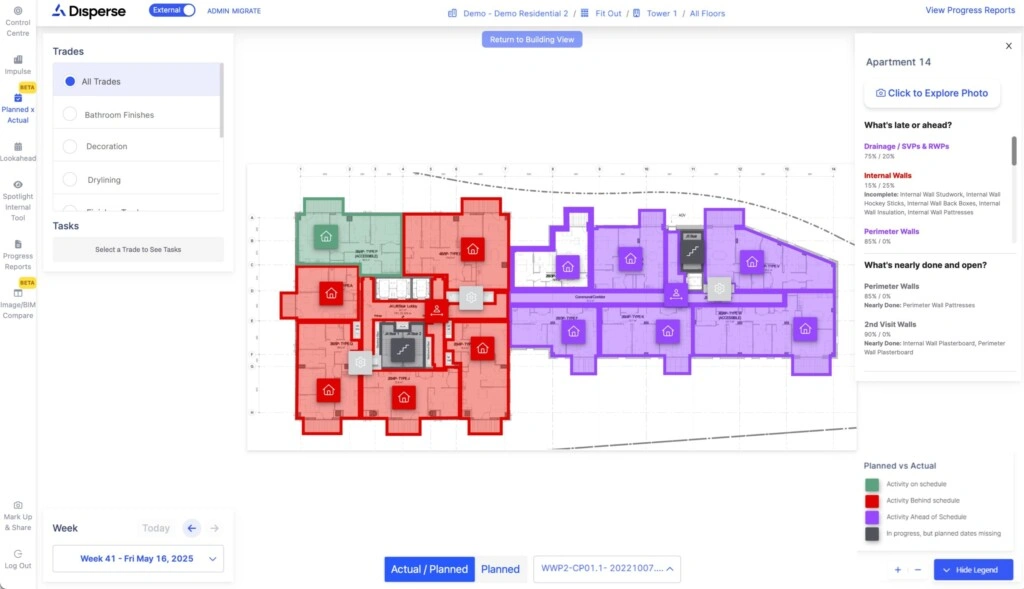
Disperse, founded in 2015 in the United Kingdom, is a progress tracking system. Its product, Impulse, took 360-degree scans, integrated them with drawings, schedule and, where available, the BIM model, and turned them into work-in-place reporting for coordination meetings, owner updates and pay applications.
The differentiator was never just the AI. Disperse paired its algorithms with an expert team – described in trade coverage as mainly trained architects and engineers – who verified the analysis. That step is slower than a black-box model, but progress percentages that support billing have to survive challenge, and verification made them defensible.
Key features
- Work-in-place tracking that, at launch, quantified over 480 task components across Superstructure, Envelope / Facade, MEP and Fit-Out
- Interactive elevations filterable by trade, task, component and location, to validate a claim against the scan
- Spotlights early-issue detection for installations that do not conform to drawings or may need rework
- Stall and pace signals showing where trades or tasks are slowing
- Automated executive, progress, cost and earned-value reports for stakeholders
- Schedule integrations listed as Oracle Primavera P6, Asta Powerproject and Microsoft Project
Pricing
Pricing is not public: listings for Disperse Impulse describe it as dependent on project details. No published rate exists, so treat any directory figure as unverified until OpenSpace quotes it.
What the pricing page does not make obvious: since the October 28, 2025 acquisition, verified in OpenSpace’s own announcement and in Construction Dive’s report of it, new customers cannot buy Disperse as a standalone subscription. OpenSpace Track, powered by Disperse, is sold as an add-on to an OpenSpace Capture subscription, at project level or across a portfolio. Existing Disperse contracts continue without interruption, but a new budget starts with Capture pricing first, then the Track add-on.
Who it’s for
General contractors and owners on large commercial projects where percent-complete drives money: validating work-in-place for billing, spotting schedule risk against planned milestones, and giving owners a visual summary. Named users in Disperse materials and trade coverage have included Gilbane, Mace, Canary Wharf Group, Lodha and Hines.
Who should skip it
Small projects should skip it: a verified scan-based service is overhead the job cannot repay, and a superintendent walk with a simpler capture tool covers documentation for far less. Teams wanting a cheap, purely automated percentage should look elsewhere – human verification is the point, and it is priced in.
Pros
- Human-verified data is more defensible for billing and disputes than unverified AI percentages
- Covers hundreds of components across structure, envelope, MEP and fit-out
- Now backed by OpenSpace’s platform and support organisation
- Established schedule integrations with P6, Asta and Microsoft Project
Cons
- No public pricing at either the old or the new add-on tier
- No longer standalone for new customers – OpenSpace Capture comes first
- Accuracy depends on regular 360 scans; capture gaps become record gaps
- Human verification cannot match a purely automated scan’s instant turnaround
FAQ
Is Disperse still available to buy?
Not as a standalone product for new customers. OpenSpace acquired Disperse on October 28, 2025, and new customers get the capability as OpenSpace Track, an add-on to an OpenSpace Capture subscription. Existing Disperse contracts continue without interruption.
How much does Disperse cost?
Pricing is not public. Listings describe the old Impulse pricing as dependent on project details, and OpenSpace does not publish a rate for the Track add-on. Budget only from a written quote that separates Capture from Track.
How is Disperse different from OpenSpace’s regular capture?
Capture documents the site; Disperse analyses it, comparing scans with drawings, schedule and model to report verified work-in-place and stalled areas.
Bottom line
As a standalone name, Disperse is finished; as a capability, it is now the verified-progress engine inside OpenSpace. If you already run OpenSpace Capture, price the Track add-on and judge it on one test: whether its percentages match your own quantity checks closely enough to put in front of an owner.