
Quick verdict
Buildcheck Review 2026: AI Drawing Review That Catches Coordination Errors Before the Field
Updated October 27, 2026 – Tested Intelligence
Quick verdict: Buildcheck uses computer vision to review 2D construction drawings for clashes, omissions and cross-discipline mismatches, then has its own experts verify the findings before they reach your team. That expert-in-the-loop step is the point: you get an actionable issue list, not raw AI noise. The trade-offs are equally clear – it works from 2D PDFs, so it cannot find true 3D clashes in a coordinated model, and its per-sheet pricing has no published rate card.
What it is
Buildcheck, at buildcheck.ai, is an AI design review platform for owners, general contractors and architects. You submit a drawing set, most usefully at 50 percent construction documents and above, and its models check the set across disciplines – architectural, MEP, structural, civil, landscaping and low voltage, plus plans, elevations, sections and details.
ENR reported in September 2026 that Buildcheck raised a $12 million Series A led by Telescope Partners, with WND Ventures, DPR Construction’s venture arm, participating – $18 million total, nine months after a $5.9 million seed. Trade coverage put paying customers at more than 110, including DPR and EllisDon. Those are reported figures, not performance guarantees.
Key features
- More than 300 checks across all disciplines, in three groups: drawing health, 2D clash detection, and omissions and logical rules
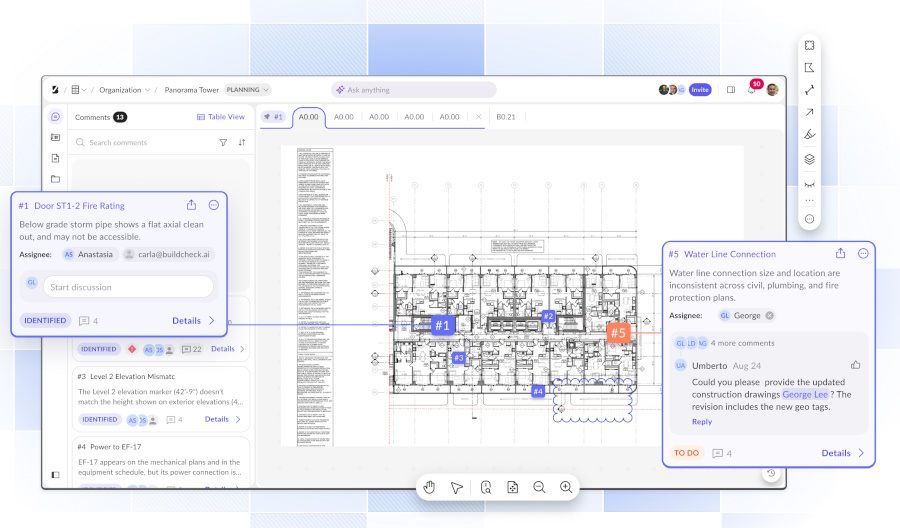
- Typical findings include missing power to equipment, door ratings that do not match wall ratings, missing fire dampers, fixtures overlapping diffusers, and pipes drawn through columns
- Expert-in-the-loop verification of every review before delivery, included by default rather than sold as an add-on
- Backcheck: re-runs an updated set to confirm previously flagged issues were actually resolved
- Drawing overlays, automatic and manually adjustable, to see what changed between revisions
- Collaboration platform with markup, comments, tagging and resolution tracking – unlimited seats included – plus analytics by discipline and person
- Syncs identified comments into Procore as coordination issues or draft RFIs; more integrations are on its roadmap, not live
Pricing
Buildcheck charges per sheet, with volume discounts, and says every review includes unlimited seats as part of the platform fee. Pricing is not public beyond that model: there is no published per-sheet rate, project price or rate card on its site, and trade coverage of its pricing describes custom quotes, with larger agreements moving to a flat per-project or construction-volume basis. It offers a trial project to start, so expect to get a number only after a conversation about your set size and review scope.
Who it’s for
Contractors, owners and design teams on services-heavy projects where coordination errors are expensive – hospitals, labs, data centers and other MEP-dense work – who review at 50 percent CDs or later. It also fits mid-market teams without a large BIM department, because it works from the 2D PDFs they already issue.
Who should skip it
Teams whose main risk is true three-dimensional clash in a ceiling void or shaft. Buildcheck works from 2D drawings, so a model-based coordination tool still does that job better, and on complex projects the two approaches are meant to run together. Also skip it if you need instant, self-serve results: turnaround is typically two days to two weeks, because a human verifies the output – a deliberate choice, but a real wait.
Pros
- Expert verification is built in, which directly attacks the false-positive problem that kills AI review tools
- Checks omissions and logical mismatches, not just geometry clashes
- Unlimited seats remove the usual per-user penalty for involving the whole team
- Backchecks close the loop on whether flagged issues were actually fixed
- SOC 2 Type II compliant, with customer data stored in the US for US customers
Cons
- 2D only – it cannot detect clashes that only exist in a 3D coordinated model
- No published rates; per-sheet cost is only knowable by quote
- Turnaround of days to weeks is slower than an instant automated scan
- Integrations beyond Procore are still described as roadmap, not available
FAQ
Does Buildcheck replace our coordination review process?
No, and Buildcheck says so itself. It is meant to improve that process by catching issues that are easy to miss in manual review before coordination meetings, so your team spends its time on higher-judgment decisions.
How long does a Buildcheck review take?
Typically two days to two weeks, depending on project size and complexity. Buildcheck says a comparable manual review would normally take six to eight weeks – that comparison is the vendor’s own figure.
What does Buildcheck cost?
It charges per sheet with volume discounts, and unlimited seats are included in the platform fee. No per-sheet rate is published, so the actual price for your project requires a quote, starting with a trial project.
Bottom line
Buildcheck is a sensible buy for teams that keep paying for drawing errors in the field, precisely because it does not pretend the AI output is finished work – an expert checks it first. Judge it on a trial project at 50 percent CDs, count how many findings your own reviewers agree are real, and price that against one avoided RFI-and-rework cycle. Just do not buy it expecting 3D clash detection or a published price list; it offers neither.