
Quick verdict

The short answer
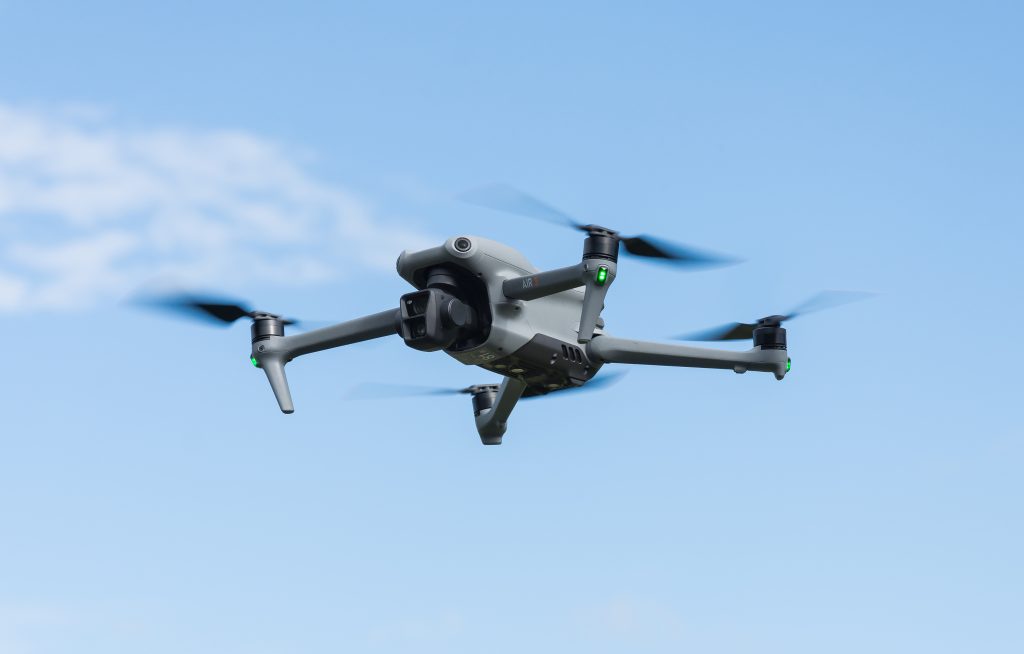
The DJI Air 3 is the drone for people who have outgrown a Mini but don’t want to pay Mavic money. Its dual-camera system — a 24mm wide-angle and a 70mm 3x medium telephoto, both on 1/1.3-inch 48MP sensors — gives you two genuinely different focal lengths for creative compression and parallax shots, both shooting 4K/60fps HDR. Add a 46-minute max flight time, omnidirectional obstacle sensing, and DJI’s O4 transmission, and you get the most versatile mid-range camera drone DJI sells. The catch: at 720 g you must register it with the FAA, and the newer Air 3S now exists with a larger main sensor — so check pricing on both before you buy.
This is a research-based review. We have not tested the DJI Air 3 hands-on; every fact below comes from the manufacturer’s published specs, pricing, and independent reporting. Prices and specs checked September 30, 2026.
Key specs
| Spec | Detail |
|---|---|
| Takeoff weight | 720 g |
| Camera system | Dual: 24mm f/1.7 wide-angle + 70mm f/2.8 3x medium telephoto |
| Sensors | 1/1.3-inch CMOS on both cameras, 48 MP stills |
| Max video | 4K/60fps HDR on both cameras; 4K/100fps; 1080p/200fps |
| Vertical video | 2.7K/60fps vertical shooting (both cameras) |
| Color profiles | 10-bit D-Log M, HLG on both cameras |
| Max flight time | Up to 46 minutes |
| Transmission | DJI O4, up to 20 km (FCC) |
| Obstacle sensing | Omnidirectional |
| Tracking | ActiveTrack 5.0, Spotlight 2.0, Point of Interest 3.0 |
| Smart features | Waypoints, Smart RTH, APAS 5.0 |
| Folded dimensions | 207 × 100.5 × 91.1 mm |
Price and availability
The DJI store lists the Air 3 from $1,099 for the DJI RC-N2 bundle (checked September 30, 2026). Fly More Combos run higher: the Fly More Combo (DJI RC-N2) was listed at $1,349 and the Fly More Combo (DJI RC 2) at $1,549 at launch, with authorized retailers such as Adorama showing the RC-N2 bundle in stock at $1,099. Confirm current pricing on the DJI store before buying, since drone pricing has moved around in 2026. The Air 3 remains widely available, but note that the DJI Air 3S — its successor with a 1-inch main sensor — is also on the market, and retailers have been discounting the Air 3 accordingly.
What it’s good at
- Two real cameras, one drone. The 70mm 3x medium telephoto is not a digital crop — it is a second 1/1.3-inch sensor with true optical zoom, giving you spatial compression and cinematic parallax that single-camera drones cannot fake. Both cameras shoot 4K/60fps HDR with matching 10-bit D-Log M and HLG color, so cuts between them match in post.
- Excellent flight time. 46 minutes of rated flight time is the best in DJI’s consumer lineup, and the Fly More battery-hub power-accumulation feature can even consolidate remaining charge across batteries.
- Flagship-grade safety. Omnidirectional obstacle sensing with APAS 5.0 automatic rerouting makes this a drone you can fly confidently in complex environments.
- Serious tracking toolkit. ActiveTrack 5.0, Spotlight 2.0, and POI 3.0 cover nearly every automated camera move a solo creator needs, and Waypoints let you pre-plan repeatable flight paths.
- Social-ready vertical video. Both cameras shoot 2.7K/60fps vertical video natively — no cropping your 4K master to feed TikTok and Reels.
- Strong transmission. DJI’s O4 system delivers a 1080p/60fps feed out to 20 km (FCC), which in practice means a rock-solid link at normal flying distances.
Where it falls short
- Fixed apertures. Both lenses have fixed apertures (f/1.7 and f/2.8), so bright daylight work still demands ND filters to hold cinematic shutter speeds.
- 720 g means paperwork. It is well over the 250 g threshold, so recreational US flyers must register with the FAA and comply with Remote ID.
- Noticeably bulkier than a Mini. It folds down well, but at 720 g it is a “backpack drone,” not a “jacket-pocket drone” — and it is only about 200 g lighter than a Mavic 3, which undercuts the portability argument.
- The Air 3S exists. DJI’s newer Air 3S upgrades the main camera to a 1-inch sensor, so the Air 3’s main selling point is now its discounted price, not its spec sheet.
- No 5.1K. Max resolution is 4K; if you want 5.1K+ reframing headroom you need to step up to the Mavic line.
Who should buy it
Enthusiast aerial photographers and content creators who want dual focal lengths, long flight times, and pro-grade tracking without paying Mavic 3 Pro prices. It is an excellent all-rounder for real estate, travel films, and YouTube work where the 3x telephoto adds shots a Mini simply cannot get.
Who should skip it
Travelers who prioritize pocketability and paperwork-free flying (get a Mini 4 Pro), professionals who need a 1-inch sensor or adjustable aperture (look at the Air 3S or Mavic 3 Pro), and anyone on a tight budget — this is a $1,100+ commitment once you add the Fly More accessories.
How it compares
The Air 3’s awkward position in 2026 is that its successor exists. The Air 3S upgrades the wide camera to a 1-inch sensor while keeping the 3x telephoto, so at equal prices the 3S is the better camera — the Air 3 only wins when discounted. Against the Mini 4 Pro ($759), the Air 3 offers a second camera, longer flight time, and better wind handling, but gives up pocketability and paperwork-free flying. Against the Mavic 3 Pro (from $2,199), the Air 3 gives up the Hasselblad main camera, adjustable aperture, and 5.1K video, but keeps dual-camera versatility at roughly half the price. In short: discounted Air 3 for value, Air 3S for image quality, Mavic 3 Pro for professionals.
Verdict
The Air 3 is DJI’s best all-round camera drone for the money: two matched 4K/60 HDR cameras, 46-minute flight time, and flagship safety features at a mid-range price. The Air 3S’s arrival makes it a “buy on discount” proposition rather than a “buy at list” one, but on sale it remains a superb value. 4.6/5
FAQ
Is the DJI Air 3 good for beginners?
It is a lot of drone for a beginner, but omnidirectional obstacle sensing and APAS 5.0 make it forgiving. That said, at 720 g and $1,099+, most beginners are better served learning on a Mini 4 Pro and upgrading once they know what focal lengths they actually use.
DJI Air 3 vs Air 3S — which should I buy?
The Air 3S upgrades the wide camera to a 1-inch sensor for better dynamic range and low light, while the Air 3’s dual 1/1.3-inch cameras are identical to each other. If the Air 3 is discounted by a few hundred dollars, it is the better value; at similar prices, take the 3S.
Do I need to register the DJI Air 3?
Yes, in the US — at 720 g it exceeds the 250 g threshold, so recreational flyers must register with the FAA and comply with Remote ID rules. Commercial flying requires a Part 107 license.
Can both cameras shoot 4K/60fps HDR?
Yes. Both the 24mm wide and 70mm telephoto cameras shoot 4K/60fps HDR with 10-bit D-Log M and HLG, and both support 2.7K vertical video for social media.
What is the real-world flight time?
DJI’s 46-minute figure is measured in ideal hover conditions. Expect 35–40 minutes of mixed flying in the real world — still excellent for the class.
Where to buy
As an Amazon Associate we earn from qualifying purchases.