
Quick verdict
ABAGY Review 2026: Self-Programming Robotic Welding Proven on Steel Bridges
Updated October 13, 2026 – Tested Intelligence
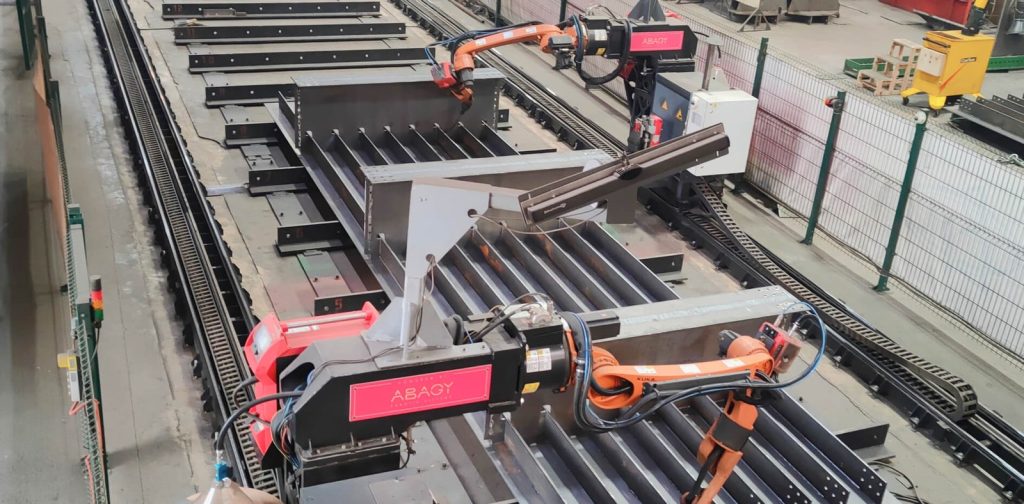
Quick verdict: ABAGY is an AI-powered robotic welding system that programs itself from CAD, using machine vision and a digital twin to find welds and adapt to real parts. Vendor case material points to steel bridge fabrication, with two complexes in use and 50+ part types per month on one cell. Pricing is not public, and there is no free trial.
What it is
ABAGY, from ABAGY Robotic Systems, is a robotic welding system built for high-mix, one-off production rather than long runs of identical parts. The vendor states that advances in artificial intelligence and machine vision have made its robots autonomous and programming-free. The software, not a programmer with a teach pendant, turns each new design into a weld program.
The vendor describes the software as AI-powered, using machine vision and a digital twin so robots identify welds and adapt to part variation. That matters for structural fabricators, where custom work is the norm and the next part rarely matches the last exactly.
Key features
- Self-programming from CAD: upload CAD and the system generates the weld program
- Machine vision and digital twin: robots identify welds and adapt to part variation
- Free part placement: place a pre-assembled part freely, with no reference points or fixturing precision required per the vendor
- Scan-and-adjust workflow: scans the work zone and adjusts the program to the real workpiece
- Broad compatibility: vendor lists Fanuc, KUKA, Yaskawa and others, and Fronius, ESAB, Lincoln, and Miller power sources, including retrofits
Pricing
Pricing is not public. The vendor states that the equipment is purchased and owned, and that the software is the recurring payment, but no amount is published for either. There is no free trial. Demos are offered, including a Chicago lab demo, but a demo is not a free trial: it is a vendor-led demonstration, not self-serve use in your own shop. Expect pricing only through a scoping and quotation process.
Who it’s for
High-mix structural and custom fabricators who own, or want, standard industrial robots for one-off work. If production changes constantly and conventional programming would cost more time than the welding itself, ABAGY’s CAD-to-weld approach is built for that problem. It also fits shops considering a retrofit of compatible robots, and heavy custom work like the vendor’s steel bridge case.
Who should skip it
Skip it if you want a published price, a self-serve trial, or a standard off-the-shelf cell. You will get none of those here: pricing requires a vendor process, there is no free trial, and cells are custom-designed. Low-mix shops may also find a conventional setup simpler.
Pros
- Programming-free workflow: CAD in, part scanned, program adjusted, no teach-pendant work
- Handles real variation instead of requiring precise fixturing and reference points
- Works with major robot and power-source brands, including retrofits of existing robots
- Reference use in steel bridge fabrication, with two complexes in use per vendor case material
Cons
- Pricing is not public for the equipment purchase or the recurring software payment
- No free trial; demos are vendor-led, not use in your own shop
- Cells are custom-designed, with no standard cell to price quickly
- High-mix focus means low-variation shops may not use the capability they pay for
FAQ
How does ABAGY work without robot programming?
You upload CAD and place a pre-assembled part freely, with no reference points or fixturing precision required. The system scans the work zone and adjusts the program to the real workpiece.
What robots and power sources does ABAGY support?
The vendor lists major robot brands including Fanuc, KUKA, and Yaskawa, and power sources including Fronius, ESAB, Lincoln, and Miller, including retrofits of existing robots.
How much does ABAGY cost, and can I try it free?
Pricing is not public. The vendor states the equipment is purchased and owned and the software is the recurring payment, with no amount published. There is no free trial, though demos are offered, including a Chicago lab demo.
Bottom line
ABAGY is built for the hardest case in robotic welding: one-off, high-mix parts that change too often for manual programming to pay. Its answer is to let AI and machine vision program from CAD, scan the real part, and adapt. The limits here are commercial: no published price, no free trial, and a custom cell every time. For a custom structural fabricator with compatible robots, that trade may be worthwhile. For anyone wanting a standard cell at a known price, it is not.