
Quick verdict
AGT BeamMaster Review 2026: AI-Programmed Robotic Welding Built for Structural Steel
Updated October 13, 2026 – Tested Intelligence
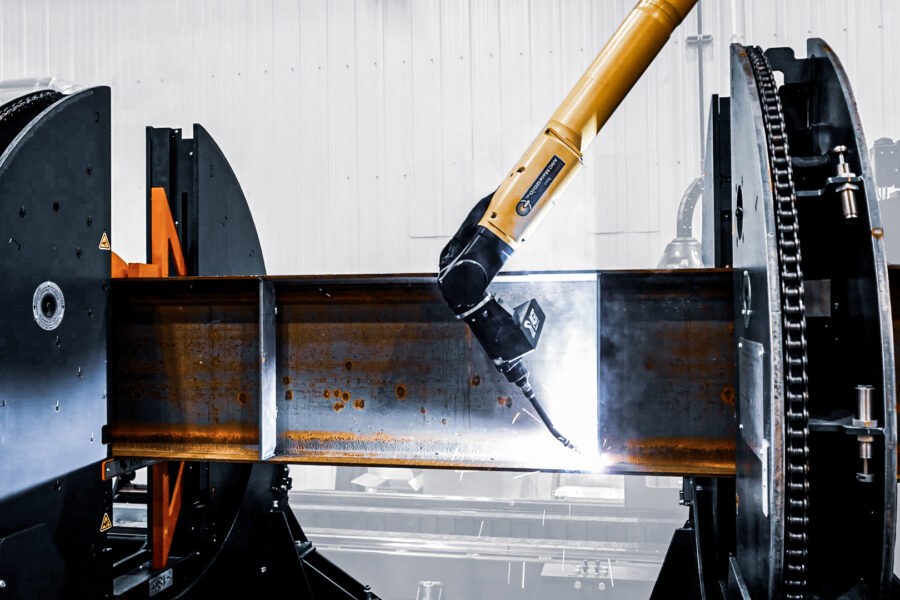
Quick verdict: AGT BeamMaster is a purpose-built robotic welding system for structural steel, with Cortex software that uses artificial intelligence to generate weld programs from the 3D model. For fabricators welding pre-fit beams and columns at volume, it offers lot-size-of-one welding without teach-pendant programming. Pricing is not public, and the full cell is large.
What it is
AGT BeamMaster, from AGT Robotics, is a robotic welding system built specifically for structural steel fabrication. It was not adapted from automotive production, where robots repeat the same weld on identical parts all day. Structural steel works the opposite way: almost every beam is unique, with different lengths, connections, and attachments from job to job.
That variation is the core problem BeamMaster targets. With a conventional robot, teach-pendant programming for each unique beam kills the return on investment. Cortex, its software, is meant to remove that step, generating the program from the model instead and adjusting to how each beam actually fits up in the cell.
Key features
- Purpose-built for structural steel beams and columns, not adapted from automotive lines
- Cortex AI programming: per trade coverage in Manufacturing AUTOMATION, it uses artificial intelligence to auto-generate weld programs and paths from the 3D model and sequence welds
- SnapCam 3D seam-finding: uses 3D point-cloud seam-finding to adjust to real fit-up
- Vendor-listed capacity: W-beams from W6 to W48, lengths up to 80 ft in two zones
- Also listed for HSS closed columns, stiffeners, crane-beam connections, and double-decker connections
Pricing
Pricing is not public. AGT Robotics publishes no price for BeamMaster in the material reviewed for this article, and no free trial is published. That is common for large, configured fabrication cells, but it means you cannot budget from a price list or test the system on a self-serve basis. Expect a vendor quotation process, and ask early how the cell configuration and software are each priced so the total is clear before you commit floor space.
Who it’s for
Structural fabricators welding pre-fit beams and columns at volume who want lot-size-of-one robotic welding without hiring a robot programmer. If your shop runs a steady flow of beams that are each different, and manual programming would eat the return on a conventional robot, BeamMaster’s model-driven approach is aimed directly at you.
Who should skip it
Skip it if you run a small or misc-steel-only shop, where volume and part size are unlikely to justify a large fixed cell. Also skip it if your beams are not pre-fit: BeamMaster expects pre-fit beams, so a workflow that relies on fitting at the welding station does not match how the system is intended to operate.
Pros
- Built for structural steel from the start, not repurposed from repetitive automotive work
- AI-generated programs remove the teach-pendant bottleneck on unique beams
- SnapCam seam-finding adjusts to real fit-up, not just the model
- Broad listed capacity: W6 to W48, up to 80 ft, plus columns and complex connections
Cons
- Pricing is not public, and no free trial is published
- Large fixed footprint: vendor lists 112 ft fence-to-fence for the full configuration
- Expects pre-fit beams, so upstream fitting discipline is required
- Suited to volume beam and column work, leaving smaller and misc-only shops out
FAQ
How does BeamMaster program welds without a teach pendant?
Cortex uses artificial intelligence to auto-generate weld programs and paths from the 3D model and sequence the welds. SnapCam then uses 3D point-cloud seam-finding to adjust to the real fit-up of the beam in the cell.
What sizes and parts can BeamMaster handle?
The vendor lists W-beams from W6 to W48 in lengths up to 80 ft in two zones, plus HSS closed columns, stiffeners, crane-beam connections, and double-decker connections.
How much does AGT BeamMaster cost?
Pricing is not public, and no free trial is published. You will need a quotation from AGT Robotics based on your cell configuration.
Bottom line
BeamMaster tackles the real reason robotic welding has been hard to justify in structural steel: every beam is different, and programming each one by hand destroys the economics. Generating programs from the model and finding seams in 3D aims to make one-off beams robot work. The trade-offs are scale and openness: a 112 ft full configuration, pre-fit beams required, and no published price. For a volume structural fabricator, those are worth weighing seriously. For a small or misc-only shop, they are reason enough to pass.