
Quick verdict
Reconstruct Review 2026: Measurable Reality Models for Progress Monitoring
Updated October 13, 2026 – Tested Intelligence
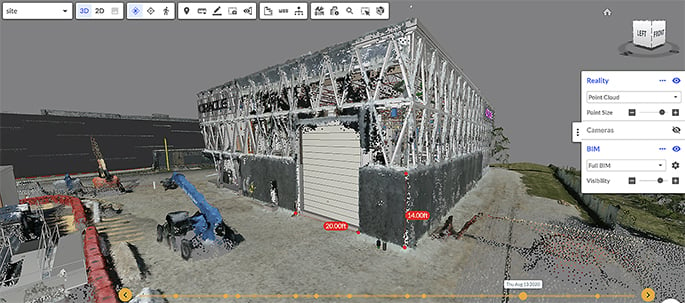
Quick verdict: Reconstruct’s Visual Command Center does one thing most capture tools do not: it turns 360 video, photos, drone footage and laser scans into a measurable 3D reality model, aligned to your BIM and schedule, so progress questions get answered with measurements instead of opinions. It is an owner-and-enterprise-grade platform with a research pedigree out of the University of Illinois. Pricing is not public – expect a quote-based sale.
What it is
Reconstruct was founded in 2016 in Menlo Park, California, around a reality-modelling engine originally developed at the University of Illinois. The pitch is “what is there vs. what should be there”: field teams capture the site with whatever they already carry – a 360 camera walk, smartphone photos, a drone flight, a laser scan – and Reconstruct stitches it into a single reality model registered against the design drawings and BIM.
Because the model is measurable, the platform goes beyond photo documentation. Teams use it for remote QA/QC, percent-complete checks and schedule-risk spotting on large programs: Texas A&M uses it across a capital program the university values at $1.5B, PennDOT has run it on multiple projects, and East Japan Railway uses it for station and bridge work. In May 2025 Reconstruct raised a strategic investment round to accelerate its AI capabilities, with the Nemetschek Group among the backers.
Key features
- Visual Command Center: reality capture, 2D drawings, 3D BIM and schedule in one integrated view
- Reality modelling engine that builds 3D point-cloud models from 360 video, still photos, drones and laser scans
- 360 video processing: walk a floor in minutes and get a registered model with images aligned to the plans
- Measurable models – the vendor claims sub-inch measurement accuracy when reality is aligned to design
- Design-vs-as-built comparison for remote inspections, QA/QC and progress verification
- Time-stamped documentation across the project lifecycle, from construction through handover and operations
Pricing
Pricing is not public. Reconstruct sells to owners, large contractors and public agencies through quotes, and nothing on its site or in directory listings gives a per-project or per-user figure to anchor on. That is normal at this end of the market – deployments are scoped around portfolio size and capture cadence – but it means procurement starts with a sales process, and smaller teams should expect the platform to be priced like enterprise infrastructure, not an app subscription.
Who it’s for
Owners and owner’s reps managing many simultaneous projects, transportation and institutional programs, and GCs on complex jobs where remote stakeholders need trustworthy, measurable progress evidence. If your meetings argue about what is actually built, a shared reality model ends the argument.
Who should skip it
Small contractors and single-project teams: the platform’s value compounds across a portfolio and a BIM-based workflow, and the quote-based enterprise sale is a heavy lift for one job. If you only need simple 360 photo documentation pinned to floor plans, lighter tools do that for less.
Pros
- Measurable 3D reality, not just photos – progress can be quantified and checked
- Accepts almost any capture source, from phone photos to laser scans
- Proven on demanding public and institutional programs (Texas A&M, PennDOT)
- Design, reality and schedule in one view supports real delay-risk conversations
Cons
- Pricing is not public, and the sales motion is enterprise-length
- Full value assumes BIM and drawings to align against – 2D-only teams get less
- Someone still has to capture the site regularly; the model is only as fresh as the last walk
- Processing and alignment add workflow steps that photo-only tools skip
FAQ
What does Reconstruct do?
It builds measurable 3D reality models from 360 video, photos, drone footage and laser scans, aligns them to BIM and drawings in its Visual Command Center, and uses that to monitor progress, verify quality and document as-built conditions remotely.
How much does Reconstruct cost?
Pricing is not public. Reconstruct is sold by quote to owners, agencies and large contractors, scoped to the deployment.
What capture hardware does Reconstruct need?
None specifically – it is source-agnostic. Teams capture with 360 cameras, smartphones, drones or laser scanners and upload the data for processing into a reality model.
Bottom line
Reconstruct is the deep end of progress monitoring: measurable reality, aligned to design and schedule, trusted on billion-dollar programs. For owners and big builders who need evidence rather than impressions, it belongs on the shortlist – with eyes open about enterprise pricing and the BIM workflow it expects.