
Quick verdict
FYLD Review 2026: Video Risk Assessments From Short Jobsite Clips
Updated October 13, 2026 – Tested Intelligence
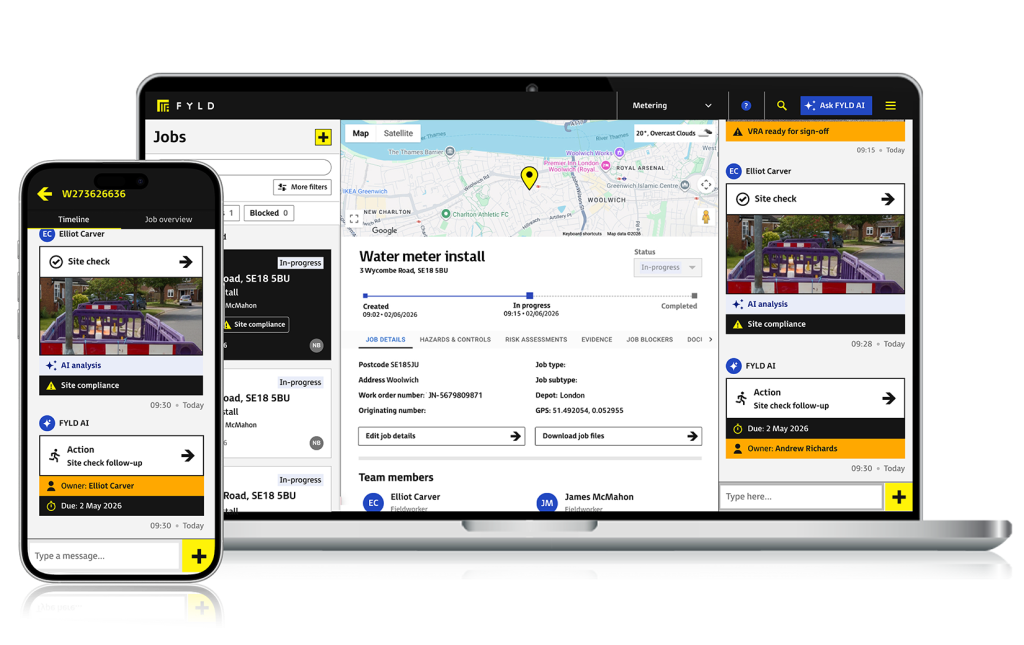
Quick verdict: FYLD replaces the static risk-assessment form with a short video: a field worker films site conditions, FYLD’s AI analyzes the footage and flags safety, quality and delivery risks, and a manager reviews and signs off remotely before work starts. It is aimed squarely at large infrastructure and utility field operations – Kiewit and Quanta Services are customers – and pricing is not public, so this is an enterprise conversation, not a credit-card signup.
What it is
FYLD is a London-based frontline-intelligence platform, founded in 2020, built for distributed, high-risk fieldwork across construction, energy and water. Its founding insight is that risk assessments written from memory, in a trailer, hours before the work, miss what is actually on the ground. A video captured at the workface, at the moment of work, does not.
The company is scaling fast. Construction Dive reported FYLD raising a $41 million Series B in February 2026, led by Energy Impact Partners with Partech participating, after closing 2025 with 82% year-over-year growth. In 2025 it added Kiewit, Quanta Services and Emery Sapp & Sons as US customers, alongside Ferrovial. FYLD says customers have cut serious injuries and incidents by up to 48% – a vendor-reported figure, so read it as a claim to test in a pilot, not a guarantee.
Key features
- Video risk assessments: crews capture short video, photo, audio and text instead of filling static forms
- AI analysis of footage that flags safety, quality and delivery risks before they escalate
- Remote manager review, sign-off and suggested controls, so work is not held up waiting for a site visit
- Automatic documentation of actions for compliance and audit purposes
- Live visibility for managers across many jobs and crews at once
- Progress and issue reporting from the field through the day, in the same capture flow
- Deployments the company says can show value in four weeks
Pricing
Pricing is not public. FYLD publishes no plans or per-user rates and sells through a sales process to infrastructure operators and large contractors. Directory listings have attached per-user figures to FYLD, but they conflict and are unconfirmed – do not budget from them. Expect enterprise pricing scaled to field workforce size, tested through a pilot with agreed safety metrics.
Who it’s for
Large infrastructure, utility and civil contractors whose field crews work spread out, far from a manager who can walk the workface – the exact setting where paper risk assessments go stale. If your problem is that supervision cannot physically see every job before it starts, FYLD’s model fits.
Who should skip it
Building contractors whose crews work on one supervised site all day gain less – a superintendent’s eyes already do this job. And note what FYLD is not: it analyzes video workers deliberately capture. If you want fixed cameras continuously monitoring a site, look at the camera-AI category instead.
Pros
- Risk assessment starts from real, current site footage – not memory or a generic form
- Remote sign-off removes the wait-for-a-manager bottleneck on distributed work
- Every capture doubles as compliance and audit documentation
- Serious momentum: $41M Series B in February 2026 and major US contractor customers
Cons
- Pricing is not public, and the buyer profile is enterprise-scale
- Depends on crews actually filming – adoption discipline makes or breaks it
- Headline injury-reduction figures are vendor-reported, not independently audited
- Strongest footprint is infrastructure and utilities; general building work is a smaller part of its story
FAQ
How is FYLD different from camera-AI safety tools?
Camera-AI tools watch fixed site cameras continuously. FYLD analyzes short videos, photos and audio that field workers capture on their phones, and turns them into risk assessments a manager signs off remotely.
How much does FYLD cost?
Pricing is not public. FYLD sells through a sales process to large field organizations, and directory per-user figures are unconfirmed – get a scoped quote and pilot terms.
Who uses FYLD?
Construction Dive’s February 2026 funding coverage named Kiewit and Emery Sapp & Sons as customers added in 2025, alongside Quanta Services and Ferrovial, with the company expecting over 40% of revenue from the US by the end of 2026.
Bottom line
FYLD is one of the cleanest ideas in field safety: film the work, let AI read the risk, get a remote sign-off, keep the record. For big distributed infrastructure work it deserves a pilot. For a single supervised building site, it is likely more system than the problem needs.