
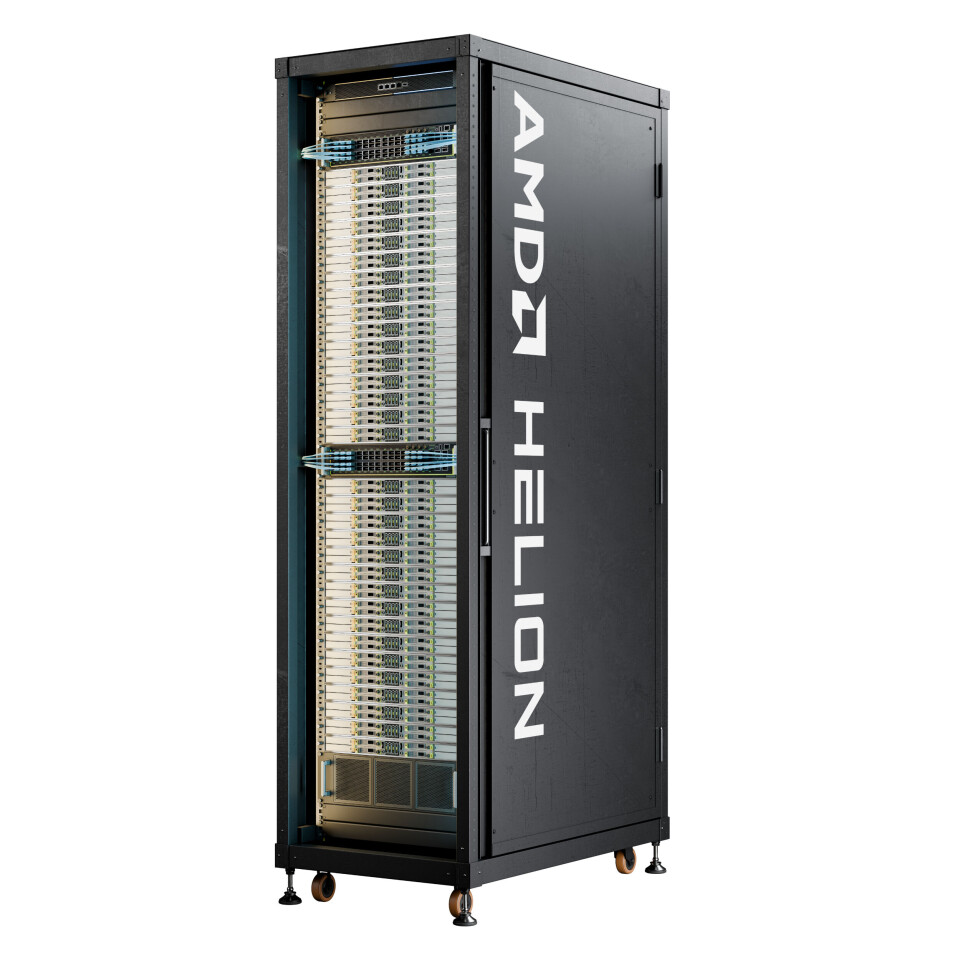
AMD unveiled Helion at the OCP Global Summit in San Jose on October 12 — an open, rack-scale reference design built specifically for running AI agents, with up to 32,768 Zen 6 CPU cores in a single rack. Partner-built Helion systems are slated to arrive from November 2026.
San Jose, October 12, 2026 — Helion joins AMD’s earlier Helios design, but aims at a different job: Helios targets frontier training and large-scale inference, while Helion is built around agent execution.
What is AMD Helion?
Helion is a blueprint, not a product AMD sells directly. It follows the Open Compute Project’s ORv4 specification in a 21-inch rack format, and AMD says it will contribute the specification to OCP so partners and the wider community can build on it. Makers developing configurations include Cisco, Dell, HPE, Lenovo, Supermicro, Hon Hai, QCT and Wiwynn.
There are two main configurations. A CPU-only hyperscale version packs up to 32,768 Zen 6 cores, delivered by 256-core versions of AMD’s Venice EPYC processors, and is meant for dedicated agent execution connected to separate inference infrastructure. An enterprise version mixes CPU and GPU blades in one rack, pairing EPYC processors with up to 16 Instinct MI350P accelerators, and supports up to 102 Tbps of networking bandwidth. Both versions come in air- and liquid-cooled variants, and AMD says the design includes an integrated token router for routing work between models.
What are the blade options?
AMD is offering dense, balanced and high-performance CPU blades. Dense blades use EPYC 9006 chips rated at 400W; performance blades use a 96-core version clocked at 5 GHz; balanced blades use 256-core processors rated at 600W. GPU inference blades put eight MI350P accelerators in a 5U server, and general-purpose blades cover database, storage and technical computing work.
AMD’s pitch, in its executives’ telling, is that agentic AI is not one workload: personal agents, enterprise applications, code execution and complex workflows each need different mixes of compute, so the rack has to adapt rather than assume everything belongs on a GPU.
Why it matters
Agents spend much of their time orchestrating — running code, calling tools, checking results — and that work is CPU-shaped. Helion is AMD betting that the agent era needs a different rack balance than the training era, and that an open OCP blueprint is the fastest way to get every major server maker shipping it. If partners hit the November target, Helion will be one of the first purpose-built agent racks buyers can actually order. Everything AI, tested — and increasingly, racked.
Frequently asked questions
How many cores does AMD Helion support?
Up to 32,768 Zen 6 CPU cores in the CPU-only configuration, using 256-core Venice EPYC processors.
When will Helion systems be available?
AMD and its partners target November 2026 for the first partner-built configurations.
What is the difference between Helion and Helios?
Helios is AMD’s rack design for frontier-scale training and large inference jobs. Helion is aimed at agentic AI — agent execution, with inference either in the same rack or connected separately.
Sources: The Register, Wccftech, AI Weekly