
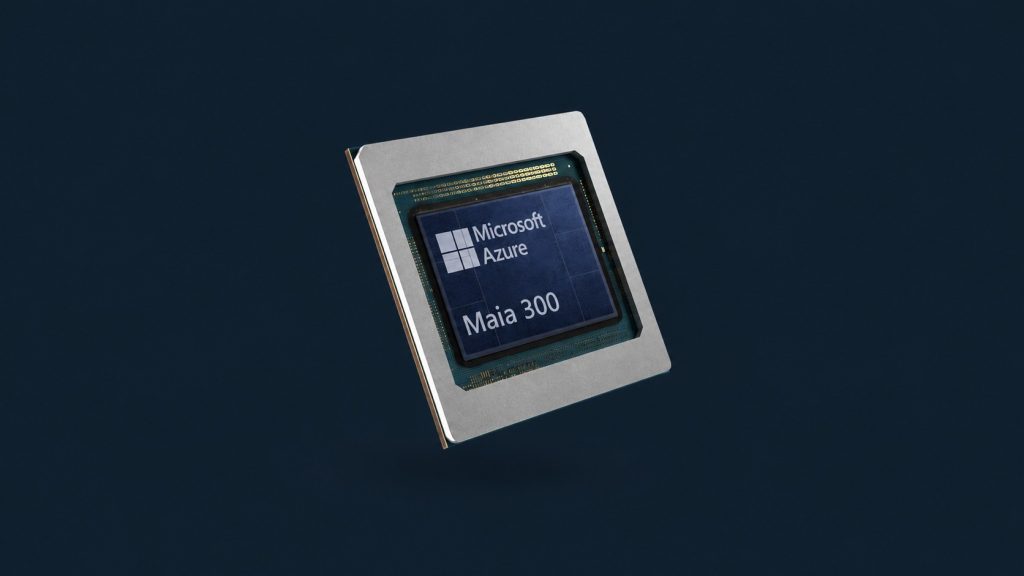
Microsoft has unveiled Maia 300, the third generation of its own AI chip, and says the Maia family will become the main inference engine behind its products and services from 2027. Why it matters: the biggest cloud companies are racing to run AI on silicon they design themselves, because buying GPUs from Nvidia is expensive and power-hungry.
October 12, 2026 — Microsoft announced Maia 300 on Monday, alongside plans to scale the Maia family to multi-gigawatt deployments starting next year. Reuters reports the company could deploy more than a million of the new chips in 2027 to back its internal AI services. CEO Satya Nadella described the push on X as the company’s biggest bet yet on its own silicon.
What happened
Maia 300 is an inference-first system, built for the workloads Microsoft says are growing fastest: long-context reasoning, fast conversational responses, and AI agents that work through multi-step tasks over a sustained period. It will not arrive overnight — production deployments begin in 2027 — but Microsoft is positioning it as the default hardware layer underneath services such as Copilot, rather than a side project. Its predecessor, Maia 200, is already in production: Microsoft says it serves Microsoft Copilot today, runs OpenAI models, Microsoft’s own MAI models and leading open-source model families, and is deploying across the United States, Europe and Australia, with GitHub Copilot and Microsoft Foundry set to follow by the end of the year.
The numbers Microsoft is claiming
Microsoft expects Maia 300 to deliver 40% more tokens per megawatt than leading GPU-based systems, although it has not named the systems it compared against, so treat that figure as a vendor claim for now. In a full rack of 96 accelerators, the company says Maia 300 delivers up to seven times the rack-scale token throughput of Maia 200. Each rack draws about 167 kilowatts and packs 27.6 TB of high-bandwidth memory. The design splits compute, memory-controller and I/O functions into separate chiplets, with the compute chiplets built on TSMC’s 2-nanometer-class N2P process; eight HBM4 memory stacks provide a claimed 18.0 TB/s of peak bandwidth within a 950-watt chip power budget.
Why it matters
For Microsoft, this is about cost and control. Every Copilot prompt answered on its own silicon is one it does not have to rent GPU capacity for, and efficiency per watt is now the binding constraint on how fast AI services can grow. Microsoft is not walking away from Nvidia or AMD — it still plans to deploy their next-generation systems — but Maia becoming the primary inference system would shift the balance of its data centers toward hardware it designs. For Azure customers and Copilot users, the practical payoff, if the efficiency claims hold up in production, is more AI capacity at a lower cost per answer. Microsoft says it will share more at its Ignite conference in San Francisco next month.
Frequently asked questions
What is Microsoft Maia 300?
It is the third generation of Microsoft’s custom AI accelerator, designed mainly for inference — running AI models to answer queries and power agents — across Microsoft’s own products and Azure data centers.
When will Maia 300 be deployed?
Microsoft says production deployments begin in 2027, scaling to multi-gigawatt deployments, with Reuters reporting a possible deployment of more than a million chips next year.
How does Maia 300 compare with Nvidia GPUs?
Microsoft claims 40% more tokens per megawatt than leading GPU-based systems, but it has not named the comparison systems or published independent benchmarks, so the claim is unverified for now.
Can Azure customers rent Maia 300 directly?
Microsoft has not announced that. Unlike Google’s TPUs or Amazon’s Trainium, Maia is aimed at Microsoft’s own services, with customers benefiting indirectly through those services.
Sources: Reuters, Official Microsoft Blog, GeekWire, Barron’s