
ProWritingAid Review 2026: The Deep-Editing Suite Fiction Writers Swear By
TL;DR: ProWritingAid is a manuscript-analysis suite that runs 20+ reports over your writing — pacing, overused words, sticky sentences, dialogue tags, clichés — not just grammar. Premium costs $30/month or $120/year, with a rare $399 lifetime license for writers who’ll use it for years. Best for novelists, thesis writers, and anyone doing serious long-form revision; a harder sell for email-and-docs users who’d be better served by a simpler checker.
What ProWritingAid actually does
ProWritingAid is a grammar and style checker built for long-form writing. The grammar engine handles spelling, punctuation, and basic style like any competitor — but the product’s identity is its report suite: 20 to 25+ specialized reports that analyze your entire document at once. The Writing Style report flags passive voice and hidden verbs; the Echoes report finds repeated words and phrases; the Pacing report maps slow and fast sections across a manuscript; the Dialogue Tags report catches your characters “exclaiming” and “interjecting” too often; and there are reports for sticky sentences, sentence length variety, overused words, clichés, and consistency (spelling, hyphenation, capitalization).
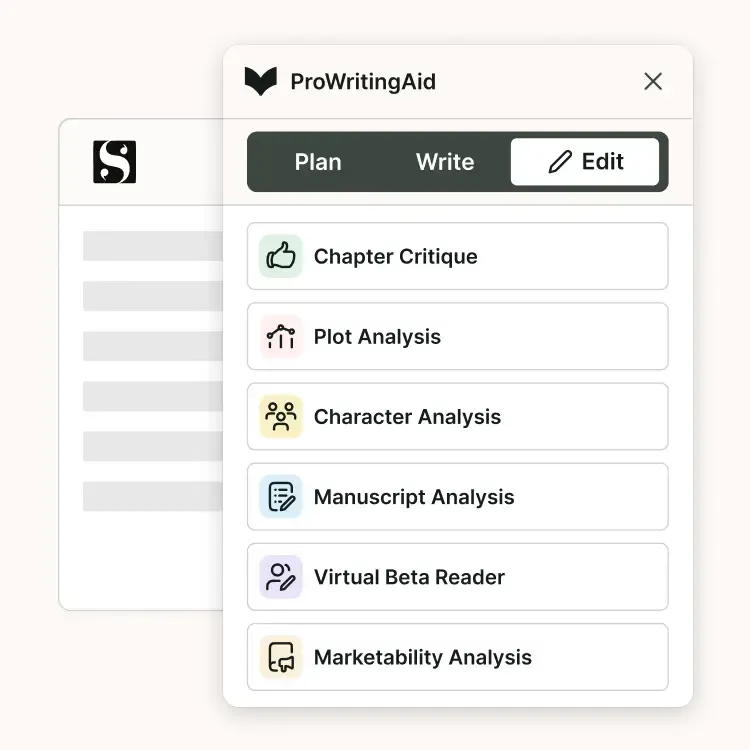
It integrates with Google Docs, Microsoft Word, Scrivener (a favorite among novelists), and Chrome, plus a web editor where you can paste text for a full analysis. Beyond editing, it includes goal tracking (daily word-count targets), writing challenges, a snippets text-expander, and a writers’ resource library. A whole-book Manuscript Analysis is available as a separate credit-based service on top of the subscription.
ProWritingAid pricing in 2026
Prices checked Oct 7, 2026. Note: ProWritingAid restructured its pricing in 2026 — the old $79/year plan is gone, annual rose to $120, and the lifetime license rose from $299 to $399. Any article quoting $79/year is out of date. There’s a 3-day money-back guarantee on annual and lifetime plans, a ~20% student discount, and free access for K-12.
| Plan | Price | Key inclusions |
|---|---|---|
| Free | $0 | 500 words per check, 2 report runs/day, 10 rephrases/day, basic reports |
| Premium | $30/month or $120/year ($10/mo) | Unlimited word count, all 20+ reports, all integrations, style guides, snippets |
| Premium Pro | $36/month or $144/year ($12/mo) | Everything in Premium plus larger AI rewriting allowance and coaching-style features |
| Premium Lifetime | $399 one-time | Full Premium feature set forever, no renewal; breaks even vs. annual in ~3.3 years |
| Premium Pro Lifetime | $699 one-time | Full Pro feature set forever |
Plagiarism checks are not included in any plan — they’re sold as separate credit bundles. The lifetime license is the standout: Grammarly has no equivalent, and for a writer who knows they’ll be revising for years, $399 for permanent access is genuinely unusual in 2026’s subscription-everything market. Watch for the historically significant Black Friday discount on the lifetime license before buying.
Pros and cons
Pros:
- The deepest writing analysis at this price — 20+ reports no competitor matches for long-form work
- $399 lifetime license is unique; breaks even against annual in about 3.3 years
- Scrivener integration makes it the natural pick for novelists
- Pacing, echoes, and dialogue-tag reports genuinely improve manuscripts, not just sentences
- Goal tracking, snippets, and writing resources add real value beyond the checker
- Student discount and free K-12 access
Cons:
- Interface is cluttered — 20+ reports can overwhelm new users
- Free tier is restrictive: 500 words per check and 2 report runs a day won’t sustain real work
- 2026 price restructure raised annual 52% ($79 to $120) — existing users felt it
- Weaker on tone and delivery feedback than Grammarly; AI rewrites are less smooth
- Plagiarism checks cost extra on every tier
- Whole-book Manuscript Analysis is a separate credit purchase, even for subscribers
Where it falls short
ProWritingAid’s depth is also its friction. New users open a dashboard of two dozen reports and don’t know where to start — the learning curve is real, and the interface hasn’t kept pace with sleeker rivals. For short-form writing (emails, docs, chat), it’s overkill: running a pacing report on a three-paragraph email is absurd, and Grammarly’s everywhere-you-type model with tone detection serves that job better. The 2026 price hike is the honest sore spot: $79 to $120 a year is a 52% increase, and while the tool is still cheaper than Grammarly’s annual plan, the jump stung loyal users. Finally, the credit-based extras (plagiarism checks, manuscript analysis) mean the headline price isn’t always the total price — budget for them if you need them.
Who it’s for
ProWritingAid is built for novelists and fiction writers doing multi-pass revision; grad students and thesis writers who need more than surface-level grammar; and long-form nonfiction authors, bloggers, and content writers working on pieces with real structure. The lifetime license is aimed squarely at writers who know they’ll be at this for years. It’s not for people who mainly need email and document polish (Grammarly’s free tier covers that better), for teams needing admin controls and tone consistency (look at Grammarly Pro or Writer.com), or for anyone who wants a simple, invisible checker — ProWritingAid demands your attention, and rewards it.
Verdict
For its niche — serious long-form revision — ProWritingAid remains the best value in writing software, even after the 2026 price increase. Nothing else gives you pacing, echoes, and dialogue analysis at $120/year, and the $399 lifetime license is a genuine bargain for career writers. Start with the annual Premium plan to confirm the workflow fits; if you’re still using it in year two, the lifetime license starts looking like the obvious move.
Frequently asked questions
Is ProWritingAid better than Grammarly?
For long-form writing and deep revision, yes — its 20+ reports (pacing, echoes, dialogue tags) go far beyond Grammarly’s sentence-level checks. For everyday writing, emails, and tone feedback, Grammarly’s free tier and simpler interface usually win. Many serious writers use both.
How much does ProWritingAid cost in 2026?
Premium is $30/month or $120/year; Premium Pro is $36/month or $144/year. Lifetime licenses cost $399 (Premium) or $699 (Premium Pro) as one-time payments. The free plan covers 500 words per check with limited reports.
Is the lifetime license worth it?
At $399, it breaks even against the $120/year annual plan in about 3.3 years. For novelists, academics, and career writers who’ll use it long-term, it’s one of the best deals in writing software. For casual users, start with annual.
Does ProWritingAid include a plagiarism checker?
Not in the base plans — plagiarism checks are sold as separate credit bundles. Factor that into the total cost if you need regular originality checks.
Does ProWritingAid work with Scrivener?
Yes. Scrivener integration is one of its signature features and a major reason fiction writers choose it over Grammarly.