
Quick verdict
AI Product Tools for WooCommerce Review 2026: Bulk AI Product Content for WooCommerce Stores
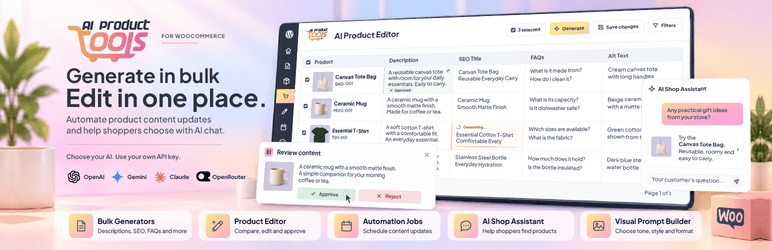
AI Product Tools for WooCommerce is a free WordPress plugin that bulk-generates product content — descriptions, titles, tags, FAQs, SEO meta, and alt text — for WooCommerce stores, plus adds a store-aware AI shop assistant for shoppers. It follows the bring-your-own-key model (OpenAI, Gemini, Claude, or OpenRouter) with no credits or markup, which keeps long-term costs transparent.
Key features
- Bulk product content generation. Generate descriptions, titles, tags, FAQs, SEO meta descriptions, and image alt text across many products at once — the full set of content that makes product pages complete for both shoppers and search engines.
- Multiple AI providers. Bring your own key from OpenAI, Gemini, Claude, or OpenRouter. Provider choice matters: different models have different strengths for copywriting, and OpenRouter in particular opens up a wide model menu.
- No credits or markup. The plugin charges nothing per generation and adds no markup — you pay your provider’s API rates directly. For high-volume catalogs, this is typically far cheaper than credit-based alternatives.
- Store-aware AI shop assistant. Beyond back-office content generation, the plugin includes an AI assistant for shoppers that understands your store — answering product questions and helping customers find what they need, which can reduce support load and bounce rates.
- SEO meta and alt text coverage. Automatically handling meta descriptions and alt text addresses two of the most commonly neglected on-page SEO elements in WooCommerce stores.
- Free plugin. No subscription from the plugin itself; costs are your API usage with your chosen provider.
Who it’s for
- WooCommerce store owners with large catalogs and thin product content — the bulk generation workflow is built exactly for the “500 products, 50 have real descriptions” problem.
- Cost-conscious merchants who prefer pay-per-use API pricing over another monthly app subscription, and who are comfortable managing an API key.
- Stores wanting an AI shopping assistant without buying a separate chatbot product — the store-aware assistant covers product Q&A in one install.
- Agencies running WooCommerce client sites that want a standardized, key-based AI content workflow without per-client credit juggling.
It is a weaker fit for merchants who want a zero-setup experience — the API key requirement is a real step — and for brands where every product description is a crafted piece of storytelling; bulk AI output will need substantial editing to reach that bar.
What to watch out for
- API key setup and cost monitoring. You need a key from OpenAI, Gemini, Claude, or OpenRouter, and bulk generation across a big catalog can consume meaningful API budget. Set usage limits and alerts with your provider before running store-wide jobs.
- Bulk output needs review. Generating FAQs, descriptions, and meta for hundreds of products multiplies both output and errors. Sample and spot-check before publishing — especially technical specs, which models will confidently invent from thin data.
- Thin data in, hallucinations out. The AI works from your product data; sparse attributes lead to plausible-sounding fabrications. Clean, complete product data improves results more than any prompt tweak.
- Shop assistant needs oversight. A store-aware AI answering shopper questions is powerful, but wrong answers about price, availability, or shipping erode trust fast. Monitor its responses, set clear boundaries on what it may claim, and keep human support reachable.
- Research-based review. We have not installed or tested this plugin ourselves; feature details come from its WordPress.org listing and documentation — re-check before depending on any specific capability.
Pricing
Pricing: check current pricing. The plugin itself is free with no credits or markup — you bring your own OpenAI, Gemini, Claude, or OpenRouter API key and pay that provider’s rates directly. Check current API pricing from your chosen provider before bulk-generating across a large store.
Pros
- Free plugin with bulk generation of descriptions, titles, tags, FAQs, SEO meta, and alt text.
- Bring-your-own-key model (OpenAI, Gemini, Claude, OpenRouter) with no credits or markup — transparent, usually cheaper at scale.
- Store-aware AI shop assistant adds shopper-facing value beyond back-office content.
- Covers neglected SEO elements (meta descriptions, alt text) that most stores skip.
- Provider choice lets you match the model to the task and the budget.
Cons
- Requires API key setup — a hurdle for non-technical merchants.
- Bulk API usage needs cost monitoring; large catalogs can surprise you.
- Bulk-generated content needs human review for accuracy and brand voice.
- Thin product data leads to hallucinated specs — data hygiene matters.
- AI shop assistant responses need monitoring to avoid wrong answers on price, stock, or shipping.
Frequently asked questions
Is AI Product Tools for WooCommerce free?
The plugin is free with no credits or markup. You bring your own API key (OpenAI, Gemini, Claude, or OpenRouter) and pay that provider’s API rates for the generation you use.
Which AI providers does it support?
OpenAI, Google Gemini, Claude, and OpenRouter — you choose by supplying your own API key, which also lets you pick the specific model and price point.
What content can it generate in bulk?
Product descriptions, titles, tags, FAQs, SEO meta descriptions, and image alt text — the full set of supporting content that fleshes out thin WooCommerce product pages.
What is the store-aware AI shop assistant?
A shopper-facing AI assistant that understands your store’s catalog and can answer product questions and help customers find items — distinct from the back-office content generation features.
How much will it cost to run on a large catalog?
It depends on your provider, model choice, and how much you generate. Because there is no markup, cost is purely your API bill — check your provider’s current per-token or per-request pricing and set usage limits before bulk jobs.