
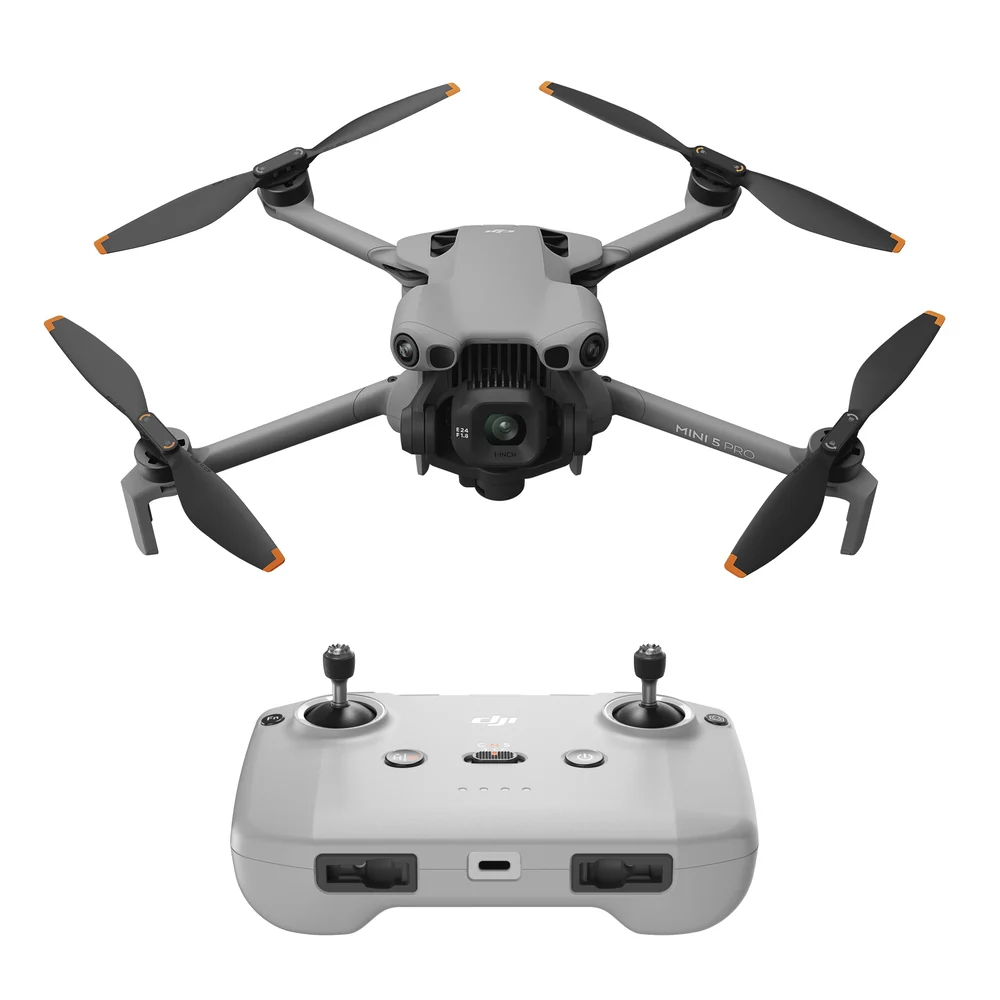
The DJI Mini 5 Pro is our overall winner for 2026: a sub-249g drone with a 1-inch sensor, true vertical filming, and AI subject tracking — the most capable registration-free drone DJI has built. Beginners get the palm-launching Neo, action shooters get the Osmo Action 4. This roundup is research-based; none of these picks were hands-on tested.
Best drones and action cameras at a glance
| Product | Standout feature | Best for | Link |
|---|---|---|---|
| DJI Mini 5 Pro | 1-inch sensor in a sub-249g body | Overall best drone | Check price on Amazon |
| DJI Mini 4K | Stabilized 4K at DJI’s lowest price | Best budget drone | Check price on Amazon |
| DJI Flip | Full prop guards, palm takeoff | Beginner-friendly creator drone | Check price on Amazon |
| DJI Neo | 135g autonomous selfie drone | Easiest first drone | Check price on Amazon |
| DJI Air 3S | Dual cameras: 1-inch wide + 70mm tele | Serious hobbyists | — |
| DJI Osmo Action 4 | 1/1.3-inch sensor, 59ft waterproof | Best value action camera | Check price on Amazon |
| DJI Mic Mini | 10g wireless transmitters | Creator audio upgrade | Check price on Amazon |
Our top picks for 2026
1. DJI Mini 5 Pro — Best drone overall
The Mini 5 Pro is the drone that makes everything else in this roundup feel like a compromise. Its 1-inch CMOS sensor shoots 50MP stills and 4K/60fps HDR — image quality previously unheard of in a drone that stays under 249g and skips FAA recreational registration in the US. The gimbal rotates a full 225 degrees for true vertical filming at full sensor resolution, a genuine advantage for short-form video creators. ActiveTrack 360 AI subject tracking keeps moving subjects locked in complex scenarios, while forward-facing LiDAR powers Nightscape omnidirectional obstacle sensing for safer dusk and night flights. With up to 52 minutes of flight time, 20km O4+ transmission, and 42GB of onboard storage, this is the most complete small-drone package DJI has ever shipped.
Pros:
- 1-inch sensor delivers the best image quality ever in a sub-249g drone.
- True vertical filming via the rotating gimbal — ideal for short-form video.
- LiDAR-assisted obstacle sensing and 360-degree ActiveTrack are genuinely useful.
Cons:
- Premium price for the Mini line.
- Extended battery pushes it over 249g, negating the registration advantage.
2. DJI Mini 4K — Best budget drone
The Mini 4K is the smartest buy for first-time pilots: real stabilized 4K video on a 3-axis mechanical gimbal, around 31 minutes of flight time, and 10km transmission — all in a sub-249g drone at DJI’s most accessible price point. One-tap takeoff and landing, GPS return-to-home, and QuickShots cinematic patterns do the heavy lifting for newcomers. Level-5 wind resistance is impressive for something this light. There are real compromises — no obstacle sensing in any direction, a smaller sensor than pricier Minis, and no advanced subject tracking — so open spaces and cautious flying are mandatory. It also makes a fine travel drone and training drone for teens. As an entry into quality drone footage without a professional budget, nothing touches it.
Pros:
- True 4K on a 3-axis gimbal at DJI’s lowest price point.
- 31-minute flight time and 10km transmission.
- Sub-249g — no FAA recreational registration.
Cons:
- No obstacle sensing at all — you are the collision-avoidance system.
- Smaller sensor means weaker low-light performance than pricier Minis.
3. DJI Flip — Best beginner-friendly creator drone
The Flip trades raw spec-sheet muscle for approachability. Its defining feature is the full-coverage propeller guard design, which makes it the safest-feeling DJI drone to fly near people — combined with palm takeoff, it launches straight from your hand with no controller required. The camera is no afterthought: a 48MP 1/1.3-inch sensor shooting 4K/60fps HDR with 10-bit D-Log M color gives footage real grading headroom, stabilized by a 3-axis gimbal. AI subject tracking and MasterShots automated cinematic sequences make polished footage genuinely easy. At under 249g it keeps the same registration advantages as the Mini line, suiting vloggers who want drone-style establishing shots without a full kit. The guards do cost some performance, and obstacle sensing is forward and downward only.
Pros:
- Full-coverage prop guards make it the safest-feeling DJI drone near people.
- Palm takeoff and AI modes make cinematic footage genuinely easy.
- 48MP sensor, 4K/60 HDR, and 10-bit D-Log M punch above the beginner label.
Cons:
- No side or rear obstacle sensing.
- Guard structure trades some performance for safety.
4. DJI Neo — Easiest first drone
The Neo is the most accessible drone DJI has ever made, and it barely asks you to learn anything. At 135g — lighter than most smartphones — it takes off from your palm, follows you with AI subject tracking, and responds to voice commands for hands-free operation. QuickShots automated patterns produce cinematic selfie moves with a single tap, and the 4K stabilized camera plus full prop guards make it reassuring for supervised beginners and parents. This RC-N3 bundle adds traditional stick flying and the full DJI Fly app for when you outgrow autonomous modes. The trade-offs are real: around 18 minutes of flight time, heavy wind sensitivity at this weight, and camera quality suited to social rather than professional work.
Pros:
- Palm takeoff, voice control, and AI tracking — no piloting skill needed.
- 135g is ultra-portable and registration-exempt for recreational use.
- RC-N3 bundle adds real manual flying when you are ready.
Cons:
- ~18-minute flight time is short; extra batteries are near-essential.
- Very wind-sensitive at this weight.
5. DJI Air 3S — Best dual-camera drone for serious hobbyists
The Air 3S is the sweet spot between the Mini line and the Mavic line: a 1-inch 50MP wide camera paired with a 70mm medium-telephoto lens, giving creators two distinct perspectives in one flight. The 4K/60fps HDR footage offers up to 14 stops of dynamic range, while 45-minute flight time, 20km O4 transmission, and nightscape omnidirectional obstacle sensing keep it in the air longer and safer than any Mini. At well over 249g, this is a “real drone” commitment — FAA registration required and stricter rules abroad. One important caution: during research, the Amazon listing for the RC-N3 configuration showed inconsistent page details suggesting a repurposed listing, so we are not linking it here. Verify the exact listing carefully before buying.
Pros:
- Dual cameras (1-inch wide + 70mm tele) offer unmatched creative flexibility in this class.
- 45-minute flight time and 20km transmission are excellent.
- Omnidirectional obstacle sensing plus smart RTH.
Cons:
- Requires FAA registration (over 249g).
- The Amazon listing showed anomalies at research time — verify before purchase.
6. DJI Osmo Action 4 — Best value action camera
Now that the Action 5 Pro exists, last generation’s flagship is this generation’s bargain. The Action 4’s 1/1.3-inch sensor still delivers excellent low-light footage for the class, shooting 4K at up to 120fps with a 155-degree field of view, 10-bit color, and D-Log M for grading. RockSteady 3.0 plus 360-degree HorizonSteady keep footage level through the roughest action, and the magnetic quick-release mount snaps between mounts in a second. Toughness is the headline: 59-foot waterproofing without a case, operation down to -4°F for ski season, and up to 160 minutes of runtime. Dual touchscreens make vlogging framing easy, and the bundle’s 64GB card means you shoot immediately. The 5 Pro only wins if you prioritize battery and low-light processing over price.
Pros:
- 1/1.3-inch sensor still delivers excellent low-light for the class.
- 4K/120, 10-bit D-Log M, RockSteady 3.0, 360 HorizonSteady.
- 59ft waterproof, -4°F cold rating, 160-min runtime.
Cons:
- Outclassed by the Action 5 Pro on battery and low-light processing.
- Bundle accessory quality varies; some filler pieces expected.
7. DJI Mic Mini — Best audio upgrade for creators
Bad audio loses viewers faster than bad video, and the Mic Mini is the easiest fix a drone or action-cam creator can buy. Each transmitter weighs just 10 grams, and the standard kit includes two transmitters plus a receiver and charging case — a two-person interview setup out of the box. The case extends total runtime to around 48 hours, transmission reaches up to 400m in open conditions, and two-level noise cancelling plus automatic anti-clipping limiting handle wind and loud moments. DJI camera owners get a standout bonus: OsmoAudio connects directly to the Osmo Action 5 Pro or Osmo Pocket 3 with no receiver needed, and Bluetooth pairing covers mobile shooting. For interviews or narration alongside drone footage, it is a dramatic upgrade over built-in camera microphones.
Pros:
- 10g transmitters are genuinely unnoticeable on talent.
- 48-hour total battery with the charging case.
- Direct OsmoAudio connection to DJI cameras — no receiver needed.
Cons:
- Real-world range is shorter than the 400m headline figure.
- Tiny components are easy to lose.
Frequently asked questions
Do any of these drones need FAA registration?
The Mini 5 Pro, Mini 4K, Flip, and Neo all stay under 249g, exempting them from FAA registration for recreational US use — commercial use requires Part 107 regardless of weight. The Air 3S is well over 249g and must be registered. Always check current local regulations before flying.
Which drone is best for a complete beginner?
The DJI Neo for the easiest experience — it takes off from your palm and flies itself with AI modes. The DJI Flip is better if you want a proper camera (48MP, 4K/60 HDR) with training wheels, while the Mini 4K is the best budget route to real drone footage.
Should I buy the Osmo Action 4 or the newer Action 5 Pro?
The Action 5 Pro wins on battery life, low-light AI processing, and internal storage. The Action 4 wins on price while keeping flagship-grade image quality, 59-foot waterproofing, and -4°F cold-weather toughness. For most casual and adventure use, the Action 4 remains the better value.
What is the best drone for vertical video?
The DJI Mini 5 Pro. Its gimbal physically rotates 225 degrees for true vertical filming at full sensor resolution, rather than cropping a horizontal frame — a real advantage for TikTok, Reels, and Shorts creators.
Can the DJI Mic Mini improve my action-camera footage?
Yes — that is arguably its biggest strength. It connects directly to the Osmo Action 5 Pro and Osmo Pocket 3 via OsmoAudio with no receiver needed, and pairs over Bluetooth to phones. For talking-head segments, interviews, or narration alongside action footage, it is a dramatic upgrade over built-in camera microphones.
As an Amazon Associate we earn from qualifying purchases.