
ResearchRabbit Review: Free Visual Literature Discovery
What ResearchRabbit is
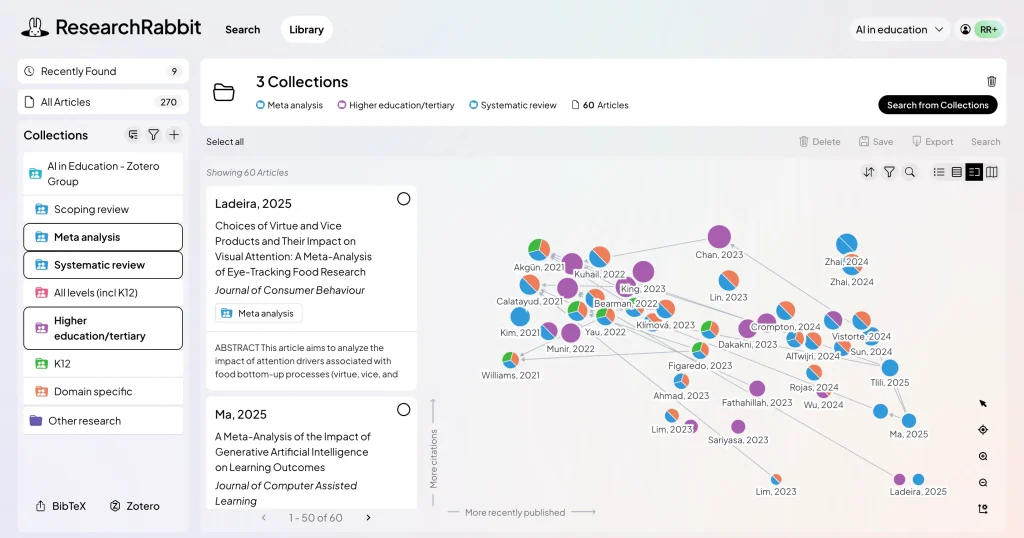
ResearchRabbit (at researchrabbit.ai) is a citation-based literature discovery platform. The workflow is simple: add one or more relevant papers as “seeds,” and ResearchRabbit analyzes citation networks to recommend similar papers, earlier foundational work, and later papers that built on yours. Results appear as interactive visualizations — network graphs and timelines — alongside list views, and recommendations update continuously as your collection grows.
It is widely trusted in academia, with over a million researchers using it at institutions including Harvard, Stanford, Oxford, and MIT. Deep Zotero integration means you can import an existing reference library and get recommendations immediately, making it a natural companion to tools you already use.
What’s actually free
Free plan ($0): unlimited searches across 270M+ papers, unlimited collections, shared/collaborative collections, and 50 seed articles — which the company describes as everything needed to complete a literature review. An optional RR+ upgrade at $10/month billed annually ($12.50 month-to-month) raises the caps: 300 seed articles, multiple projects, and Signals alerts for new relevant papers. Free-tier details checked October 2026.
Key features
- Seed-paper recommendations: similar papers, earlier foundational work, and later citing papers from your seeds.
- Visual discovery: network graphs and timeline views reveal how a field connects and evolves.
- Collections: organize papers into thematic collections that keep generating recommendations.
- Zotero integration: two-way sync — import libraries, export discoveries.
- Author tracking: follow authors from your collection and get alerted to their new publications.
- Collaboration: shared collections for research teams.
Pros and cons
Pros
- Core discovery workflow is completely free — no credits, no paywalled essentials
- Visualizations make a field’s structure visible in a way lists never do
- Recommendations improve as your collection grows
- Excellent Zotero integration fits existing academic workflows
- Trusted at major research institutions worldwide
Cons
- Discovery only — no AI summaries, PDF analysis, or synthesis features
- Large graphs can feel overwhelming without good seed papers
- Quality of recommendations depends heavily on the quality of your seeds
- Heaviest users will want the paid RR+ upgrade for higher caps
Who it’s best for
ResearchRabbit is best for students starting a literature review, researchers entering a new field, and anyone who thinks visually. If your task is “I have one good paper and need to see the neighborhood,” nothing free does it better. Pair it with Elicit or SciSpace when you need to analyze the papers you discover.
FAQ
Is ResearchRabbit free?
Yes — the free tier includes unlimited searches, unlimited collections, and 50 seed articles, which covers a full literature review. RR+ is an optional paid upgrade for higher limits.
How is ResearchRabbit different from Connected Papers?
Connected Papers generates a single beautiful graph from one seed paper — great for a quick overview. ResearchRabbit builds living collections whose recommendations update as you add papers, with Zotero sync and author tracking for ongoing discovery.
Does ResearchRabbit work with Zotero?
Yes, with full two-way integration: import your Zotero library to seed recommendations and send discoveries back.
What are seed papers?
Seed papers are the starting papers you provide — typically the most relevant ones you already know. ResearchRabbit uses their citation relationships to find related work.
Who owns ResearchRabbit?
ResearchRabbit is an independent company focused on academic discovery tools. It is not owned by a publisher, which matters to researchers wary of data lock-in.
How many papers does ResearchRabbit cover?
ResearchRabbit’s discovery spans hundreds of millions of papers — its free tier advertises unlimited searches across more than 270 million articles, drawing on sources including Semantic Scholar’s academic graph.
Is my research data private on ResearchRabbit?
Your collections are private to your account unless you explicitly share them. Shared collections are the collaboration mechanism, so nothing is public by default. As with any free service, check the current privacy policy before uploading sensitive unpublished work.
Can ResearchRabbit find full-text PDFs?
ResearchRabbit is a discovery layer, not a document host: it surfaces paper metadata, abstracts, and links, and full-text access depends on open-access availability or your institutional subscriptions. Use the Zotero integration to manage the PDFs you do have access to alongside your discoveries.
Bottom line
Based on specs, pricing, and published reviews, ResearchRabbit is one of the highest-value free tools in academic research: unlimited discovery, visual maps, and Zotero sync for zero dollars. It will not summarize papers for you — but for finding the papers worth reading, it is close to indispensable.
Free-tier details checked October 2026. Based on published specs and pricing; not hands-on testing.