
Quick verdict
Salvagnini P4 Review 2026: Automatic Panel Bending With Adaptive MAC3.0 Control
Updated November 26, 2026 – Tested Intelligence
Quick verdict: The Salvagnini P4 is an automatic panel bender for sheet metal shops that live in high-mix, low-volume work: universal tools adapt in-cycle with no manual retooling, and MAC3.0 sensors compensate for material variation as it bends. It is capital equipment, not a press-brake upgrade — pricing is not public, and its headline thickness only holds at 90 degrees.
What it is
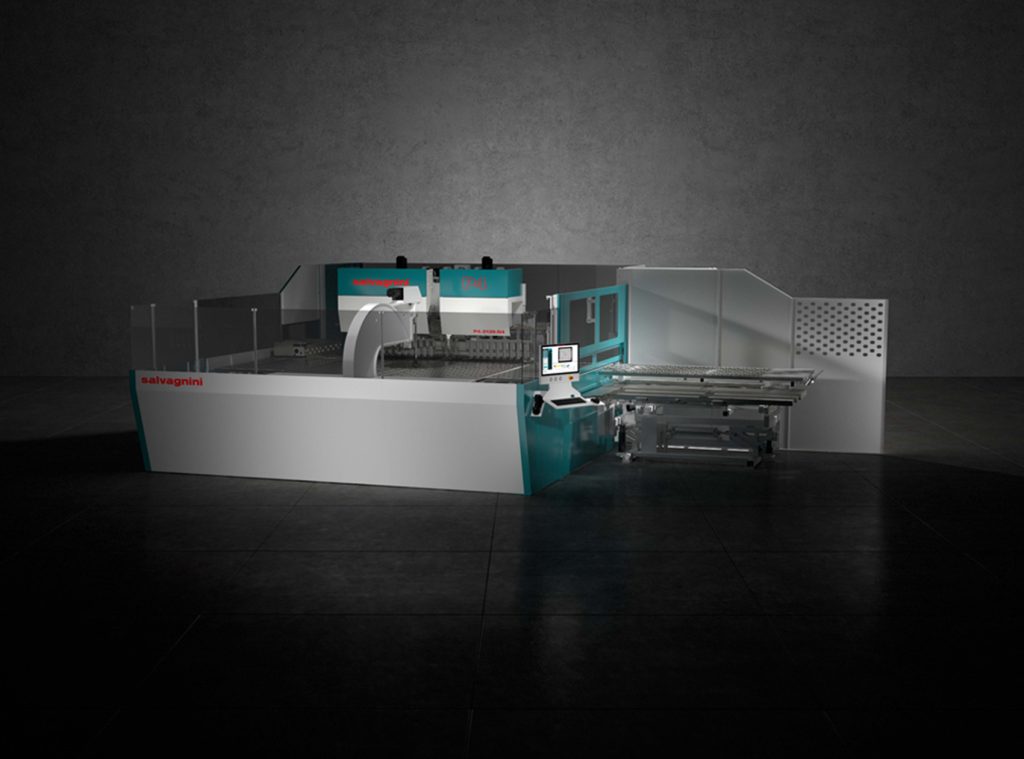
Salvagnini invented the panel bender in 1977, and the P4 is its most versatile current model, offered in 15 configurations. Instead of a press brake’s punch and die, the P4 uses four universal tools — upper and lower blades, a counterblade and an automatic blankholder — plus a manipulator that positions the sheet. The sheet is centered once at the start, so dimensional errors are absorbed by the first bend, and the machine completes bends on all sides without the operator flipping the part.
The P4 runs standalone, in a cell, or in a line such as the S4+P4 punch-shear-bend system, with STREAM programming, OPS production management and LINKS IoT monitoring connecting it to the office and ERP.
Key features
- MAC3.0 adaptive system: sensors, formulas and algorithms measure thickness, blank size and temperature-driven deformation in-cycle and compensate for material variability automatically
- Universal bending tools: blades and blankholder adapt in-cycle to panel geometry, with no downtime or manual retooling, enabling true batch-one and kit production
- Proprietary bending formula: calculates force and tool movements in real time from deflection, temperature and thickness data
- Throughput: an average of 17 bends per minute in the vendor’s published cycles, with documented parts in under 60 seconds for doors, elevator and refrigerator panels
- Software stack: STREAM for programming, OPS for ERP-linked production sequencing, LINKS for real-time performance monitoring, and the FACE human-machine interface
- Options: CLA auxiliary blades for short tabs, CUT cutting, DPM manipulator for parts down to 105 mm wide, and P-Robot automation
Pricing
Pricing is not public. The P4 is sold as configured capital equipment after a feasibility study on your key parts, with 15 models, automation options and line integration all moving the quote. Budget for installation, programming and ERP integration on top of the machine — there is no list price to anchor on.
What the pricing page doesn’t make obvious: the thickness headline is angle-dependent, and it is in the vendor’s own technical table. Mild steel at UTS 410 N/mm2 is rated 3.2 mm only to plus-or-minus 90 degrees; at plus-or-minus 120 to 130 degrees the limit drops to 2.5 mm, and at 135 degrees to 2.1 mm. Stainless falls to 2.5 mm at 90 degrees and 1.6 mm at the widest angles. A shop quoting acute bends in thick stock on the 3.2 mm headline will be disappointed — check your worst bend, not the brochure number.
Who it’s for
Sheet metal fabricators making enclosures, doors, elevator panels and HVAC housings in mixed batches, where press-brake setup eats the day. FF Journal’s coverage of IMS Engineered Products, which installed a P4-3125 in 2023, notes it handles parts too cumbersome for a press brake — parts needing two operators to hold — with quick setup.
Who should skip it
Shops whose work is heavy plate, very long bends beyond the model’s table, or simple high-volume parts a press brake already runs cheaply should skip it. So should buyers who need a published price or a small footprint on a job-shop budget: this is a six-figure-class capital decision with a feasibility study, not an online purchase.
Pros
- No retooling between parts — universal tools adapt in-cycle
- MAC3.0 compensates for real material variation instead of nominal values
- One centering per part keeps dimensions consistent across the panel
- Batch-one and kit production fit high-mix sheet metal work directly
- 15 models plus line and robot options let the system grow with the shop
Cons
- No published pricing — every purchase is a quoted capital project
- Maximum thickness drops sharply as bend angle widens past 90 degrees
- Panel format limits part geometry versus an open press brake
- Full value needs STREAM, OPS and ERP integration work, not just the machine
- Best economics assume high-mix work; simple long runs underuse it
FAQ
How is a panel bender different from a press brake?
A press brake forms one bend at a time with part-specific tools while the operator repositions the sheet. The P4 forms bends on all sides with universal blades, centered once, so setup and handling largely disappear between parts.
How much does the Salvagnini P4 cost?
Pricing is not public. Salvagnini quotes each of the 15 models by configuration, options and automation level after a feasibility study. Treat any third-party figure as a directory estimate, not a vendor price.
What thickness can the P4 bend?
From the vendor’s technical data: up to 3.2 mm mild steel at 90 degrees, falling to 2.5 mm around 120 to 130 degrees and 2.1 mm at 135 degrees; stainless to 2.5 mm at 90 degrees; aluminium to 4.0 mm at 120 degrees. Exact limits vary by model in the P4 range.
Bottom line
For high-mix sheet metal shops, the P4’s adaptive MAC3.0 control and zero-retooling universal tools are a real productivity system, proven in enclosure and HVAC shops. Go in clear-eyed: pricing is quote-only, and the thickness you can actually bend depends on the angle you need.