
Quick verdict
Petasense Review 2026: Wireless Vibration Monitoring With an ML Health Score
Updated November 25, 2026 – Tested Intelligence
Quick verdict: Petasense is an end-to-end condition-monitoring system for maintenance and reliability teams: battery-powered Vibration Motes watch rotating equipment continuously, and the ARO Cloud turns that data into a machine-learning health score so technicians work the machines that are actually going bad. Pricing is not public, and the real cost driver is how many measurement points you instrument — not seats, because ARO carries unlimited user licenses.
What it is
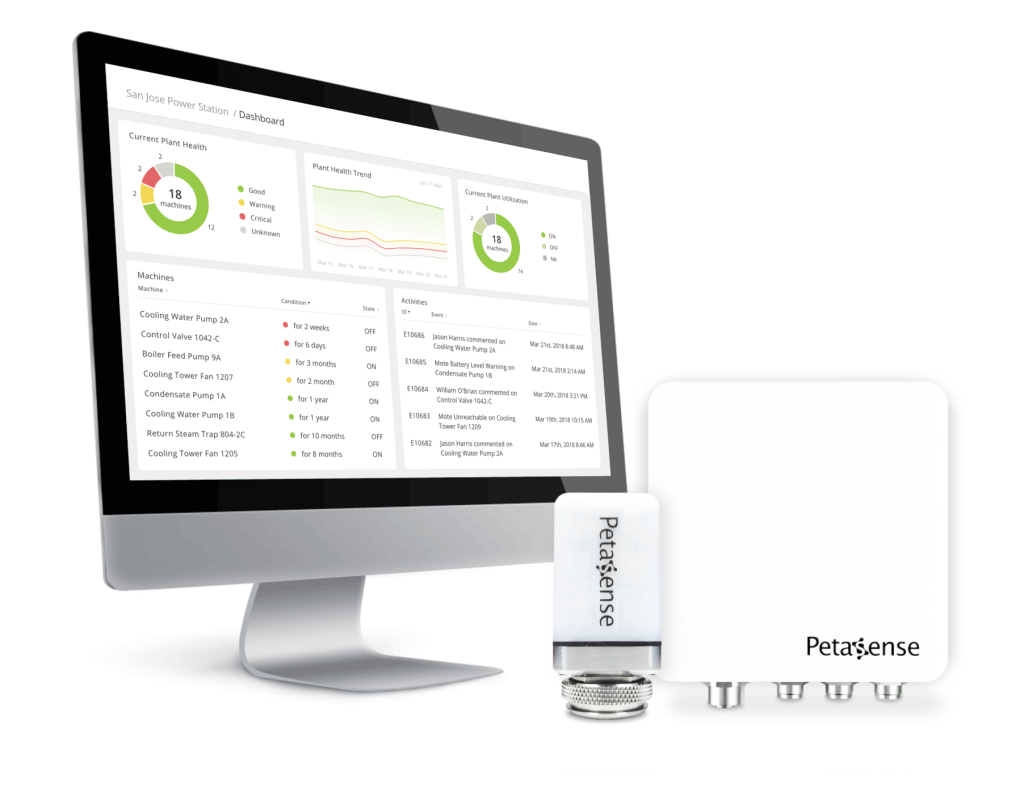
Petasense sells an Asset Reliability & Optimization (ARO) system with three parts: wireless sensors, a cloud analytics platform and web and mobile apps. The Vibration Mote is a compact, battery-powered triaxial vibration and surface-temperature sensor that mounts on a pump, motor, fan or compressor and transmits over standard WiFi. The Transmitter accepts up to nine wired sensor channels for assets needing more than vibration. ARO Cloud, on Google Cloud, processes the data with machine-learning analytics.
Petasense has operated as part of AssetWatch since January 2024, while still selling under its own name — worth knowing at contract time, because AssetWatch’s wider business is monitoring as a managed service.
Key features
- Machine-learning health score: ARO analyzes numerous asset-specific parameters and reduces them to one health score per machine, so crews triage by exception instead of reading every spectrum
- Vibration Motes: wireless triaxial vibration plus temperature, battery powered, rated IP67 and Class I, Division II for hazardous areas, per trade coverage of the vendor’s specs
- Transmitter module: up to nine sensor channels through three M8 ports, for current, pressure, ultrasound and other wired signals alongside vibration
- Full analyst toolset: trend, waveform and spectrum graphs with harmonic cursors, configurable Fmax and a bearing-tone database, plus demodulated spectra for early bearing faults
- Integrations: REST APIs plus connections to process historians and CMMS/EAM systems, so health data lands next to process data and work management
Pricing
Pricing is not public. Petasense sells sensors plus an ARO Cloud subscription, quoted per deployment. Older launch-era reporting cited sensor prices in the few-hundred-dollar range, but those figures are dated — get a written quote separating Motes, Transmitters, WiFi work, subscription and integration.
What the pricing page doesn’t make obvious: the seat math is favorable. In the vendor’s own description, ARO carries unlimited user licenses with role-based access — technician, engineer and manager see the same record with no per-seat negotiation. The budget question is coverage: every measurement point needs hardware, so a plant-wide rollout is a capital decision point by point, and low-value motors may never justify a dedicated Mote.
Who it’s for
Maintenance and reliability teams in plants where failures happen between quarterly walkaround routes. In the vendor’s published Hawaii utility story, a site instrumented 8–10 critical assets with twenty Motes in a day, then caught a deteriorating boiler feed pump motor early enough to act before an unplanned outage. If your critical pumps and motors are only seen four times a year, continuous coverage is the pitch.
Who should skip it
Small shops with a handful of non-critical machines should skip it — per-point hardware plus a subscription will not beat a handheld route at that scale. Teams without WiFi at the assets should pause: the Mote talks WiFi, so network work is part of the install cost. Buyers wanting a published price will find none.
Pros
- Continuous monitoring catches defects that grow between quarterly routes
- One ML health score makes triage fast for technicians and managers alike
- Analyst-grade spectrum tools are in the same system, not a separate package
- Unlimited user licenses remove the per-seat penalty for sharing data
- Open REST APIs and historian/CMMS integrations avoid a data silo
Cons
- No published pricing for hardware, subscription or gateways
- Every measurement point needs its own hardware — coverage scales in cost
- Motes depend on plant WiFi at the asset location
- Two Mote bandwidth versions (1.6 kHz and 5.5 kHz) detect different fault sets, so picking the cheaper unit can miss early bearing wear
- Now part of AssetWatch — confirm the self-service versus managed-service model in writing
FAQ
How is Petasense different from a walkaround vibration route?
A route collects a snapshot every few weeks; Motes collect continuously and stream to ARO Cloud, where machine learning trends a health score per asset. The vendor’s Hawaii case is the clearest illustration: hourly monitoring caught a pump motor defect that would have failed before the next route reading.
How much does Petasense cost?
Pricing is not public: purchased hardware plus an ARO subscription sized to your footprint, quoted by sales. The vendor documents one relief — unlimited user licenses — so the quote should turn on measurement points, not technician logins.
Does Petasense replace a vibration analyst?
No. The health score tells you where to look; ARO still provides the spectrum and waveform tools an analyst uses to confirm a fault. It is continuous triage, with diagnostic depth kept in-house.
Bottom line
Petasense is a credible step up from route-based monitoring for plants whose failures hide between readings: simple wireless hardware, a health score anyone can read, and real analysis tools underneath. Pricing is quote-only, coverage is bought point by point, and your WiFi has to reach the machines.