
Quick verdict
TL;DR: Alpamayo 2 Edge is NVIDIA’s 2-billion-parameter reasoning vision-language-action model built to run inside a vehicle on DRIVE AGX Thor, not in a data center. It plans driving trajectories and explains them in Chain-of-Causation reasoning, hits 160-190 ms pixel-to-trajectory latency after optimization, and in NVIDIA’s AlpaSim testing drove about 60x farther between at-fault incidents than the 4B Qwen-Drive-1.0 baseline. It is a developer foundation model for AV teams — not a product car buyers can purchase.
What is Alpamayo 2 Edge?
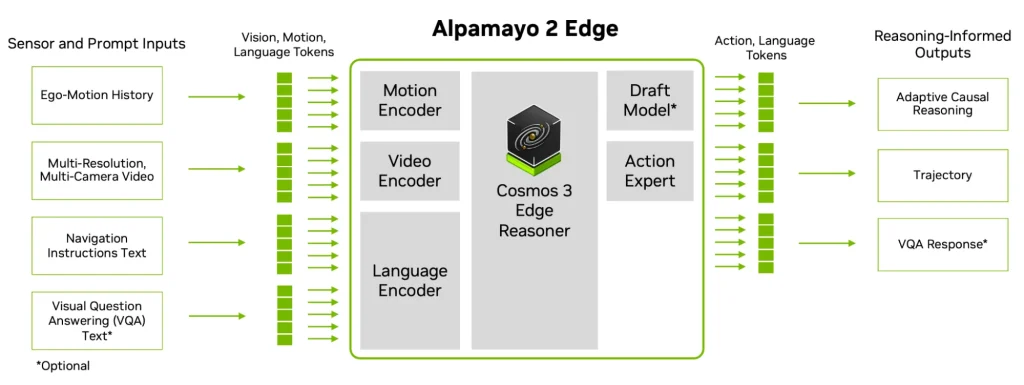
Released November 22, 2026, Alpamayo 2 Edge is built on the 2B Nemotron-based reasoning backbone of Cosmos 3 Edge, paired with a diffusion action expert. It takes surround-camera video, temporal context, ego-motion history, and navigation text, and outputs both a future trajectory and a causal explanation of why. Crucially, it reasons adaptively: in routine driving it can emit a special NOMINAL token instead of a full reasoning trace, conserving onboard compute.
NVIDIA post-trained it with closed-loop reinforcement learning in AlpaGym, which improved closed-loop driving performance by 128.5% over the best checkpoint without closed-loop RL. Reasoning quality itself is scored by AlpaJudge, a human-calibrated evaluation model used to select training data and provide RL rewards.
What the announcement doesn’t make obvious
Info-gain, verified in NVIDIA’s technical blog: the weights download from Hugging Face in BF16 and run as a plain PyTorch model on any supported NVIDIA GPU — but real-time Thor performance requires the full deployment recipe: stage the DFlash2 drafter, calibrate FP8 scales, export ONNX graphs, and build TensorRT engines with TensorRT-Edge-LLM. The quoted 160-190 ms latency is the optimized result on DRIVE AGX Thor-X (DRIVE OS 7.2.7.0, CUDA 13.4, TensorRT 11.3.1.9), not the out-of-the-box number.
Pricing
| Option | Cost | Notes |
|---|---|---|
| Model weights (Hugging Face: nvidia/Alpamayo2-Edge) | Free to download | Developer model; target hardware is DRIVE AGX Thor |
| Hosted consumer product | None | No subscription, no car-buyer product — AV developer stack only |
Strengths
- Explainable driving: Chain-of-Causation traces alongside trajectories
- Adaptive reasoning saves compute in routine scenes
- Closed-loop results: 15.15 km vs 0.25 km between at-fault incidents vs Qwen-Drive-1.0 (4B) in AlpaSim; minADE 0.53 m vs 1.68 m
- Closed-loop RL gain of 128.5% from AlpaGym post-training
- Partner reports: PORT kept its lane in more than twice as many runs as Alpamayo 1.5; Embedl ran it at 10 Hz on AGX Thor in under 48 hours
Weaknesses
- Useless outside AV development — no consumer or general-purpose use
- Real-time speed needs the full TensorRT/FP8 optimization recipe
- Benchmarks are NVIDIA’s own AlpaSim and partner evaluations, not independent road testing
- Tied to NVIDIA hardware and the DRIVE stack
How it compares
Like Inkling 2 Mini and Ling-3.2-air, this is an open-weight release — but where those target general chat, coding, and automation, Alpamayo’s entire design budget went to latency and closed-loop driving. For a hosted open-weight agent alternative, see our Sarvam-105B-1711 review.
Who it’s for
Autonomous-vehicle developers building reasoning-based driving stacks on NVIDIA DRIVE AGX Thor who need trajectories they can explain and audit.
FAQ
Can I buy Alpamayo 2 Edge for my car?
No. It is a developer model for AV teams building on DRIVE AGX Thor, not a consumer product.
How fast is Alpamayo 2 Edge?
After TensorRT optimization on Thor, 160-190 ms pixel-to-trajectory depending on how much reasoning a scene triggers.
What does adaptive reasoning mean?
In routine driving the model emits a NOMINAL token instead of a full reasoning trace, saving onboard compute for harder scenes.
Is Alpamayo 2 Edge open?
The weights are on Hugging Face as nvidia/Alpamayo2-Edge and run in BF16 as a PyTorch model before edge optimization.
Verdict
The most interesting AV release of the month for developers: small, explainable, and measurably stronger in closed-loop simulation — with the honest caveat that the headline latency is earned through a real optimization pipeline, not a download.